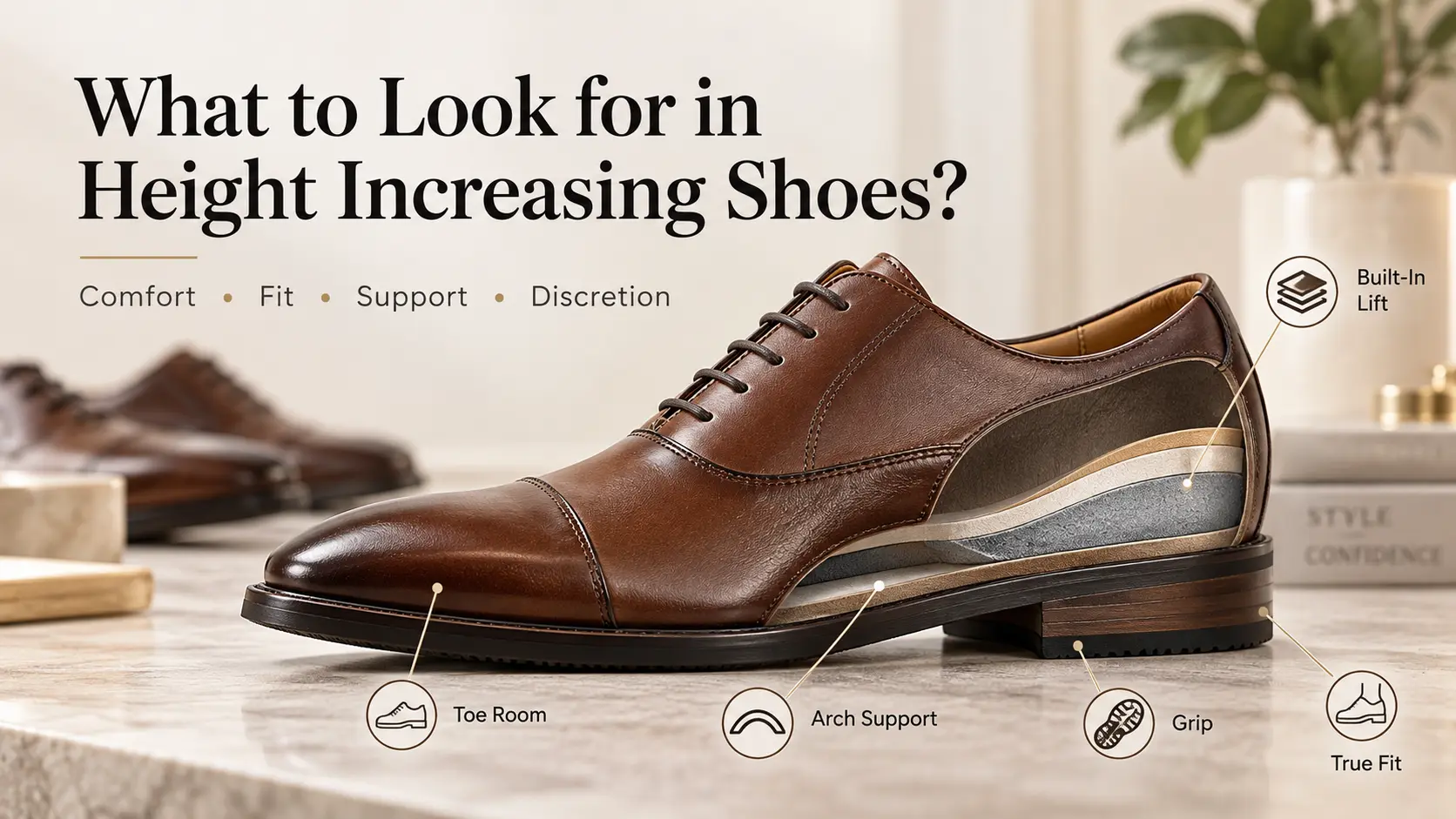
You can add 2 to 3.5 inches (5 to 9 cm) of real physical height—plus another 1 to 1.5 inches of visual height—by pairing purpose-built elevator shoes with matching, no-break trousers.
Standard men’s dress shoes only add about 1 inch (2.5 cm). Loose aftermarket insoles add another inch, but they push your heel out of the shoe and strain your arches.
If you want a natural stride and an invisible boost, you need footwear built around a deeper shoe last (the 3D foot-shaped mold used to construct a shoe) and pants tailored to keep a clean vertical line from waist to floor.

Quick Decision Summary
- Best for daily office & formal events: Built-in elevator dress shoes (2.4″–2.8″ / 6–7 cm lift) paired with dark, no-break trousers.
- Best for maximum invisible height: Formal height-boosting dress boots or Chelsea boots (2.8″–4.0″ / 7–10 cm lift). The higher ankle shaft stays completely hidden under pant legs.
- Best for casual weekends: Monochromatic low-top elevator sneakers (2.0″–2.4″ / 6–7 cm lift) matched to the color of your chinos or jeans.
- The 5% Proportion Target: Evolutionary psychology data shows men get the highest attractiveness ratings when their legs appear 5% longer than average. Adding 2.7 inches (7 cm) below the ankle hits that exact mark for a 5’6″ man.
1. How Much Height Do You Actually Need? (The Numbers)
Adding just 2 to 2.5 inches takes a 5’6″ (168 cm) man right to the American average. According to physical measurement data from the U.S. Centers for Disease Control and Prevention (CDC), the average adult man in the United States stands 68.9 inches tall (almost 5’9″ or 175 cm) (CDC FastStats: Body Measurements).

Those two inches change how people respond to you in a room:
- Higher career earnings: Each inch of height above average correlates with roughly $789 more per year in income. Researchers Timothy A. Judge and Daniel M. Cable tracked thousands of workers across four long-term studies in the Journal of Applied Psychology and found that taller men consistently scored higher in workplace authority and promotion rates (PubMed: PMID 15161403 | APA Summary).
- Greater personal confidence: Actual physical height accounts for 32.0% of the difference in how satisfied men feel about their stature—more than four times the impact seen in women. Sociologist Gert Stulp and his team confirmed this after analyzing 650 subjects alongside a broader dataset of 52,677 adults in Personality and Individual Differences (Full Study PDF | Semantic Scholar).
2. Physical Lift vs. Visual Height: The 5% Leg-Length Rule
Shoes make you look taller in two ways: they raise your heel bone off the floor, and they lengthen your Leg-to-Body Ratio (how long your legs look compared to your upper body).
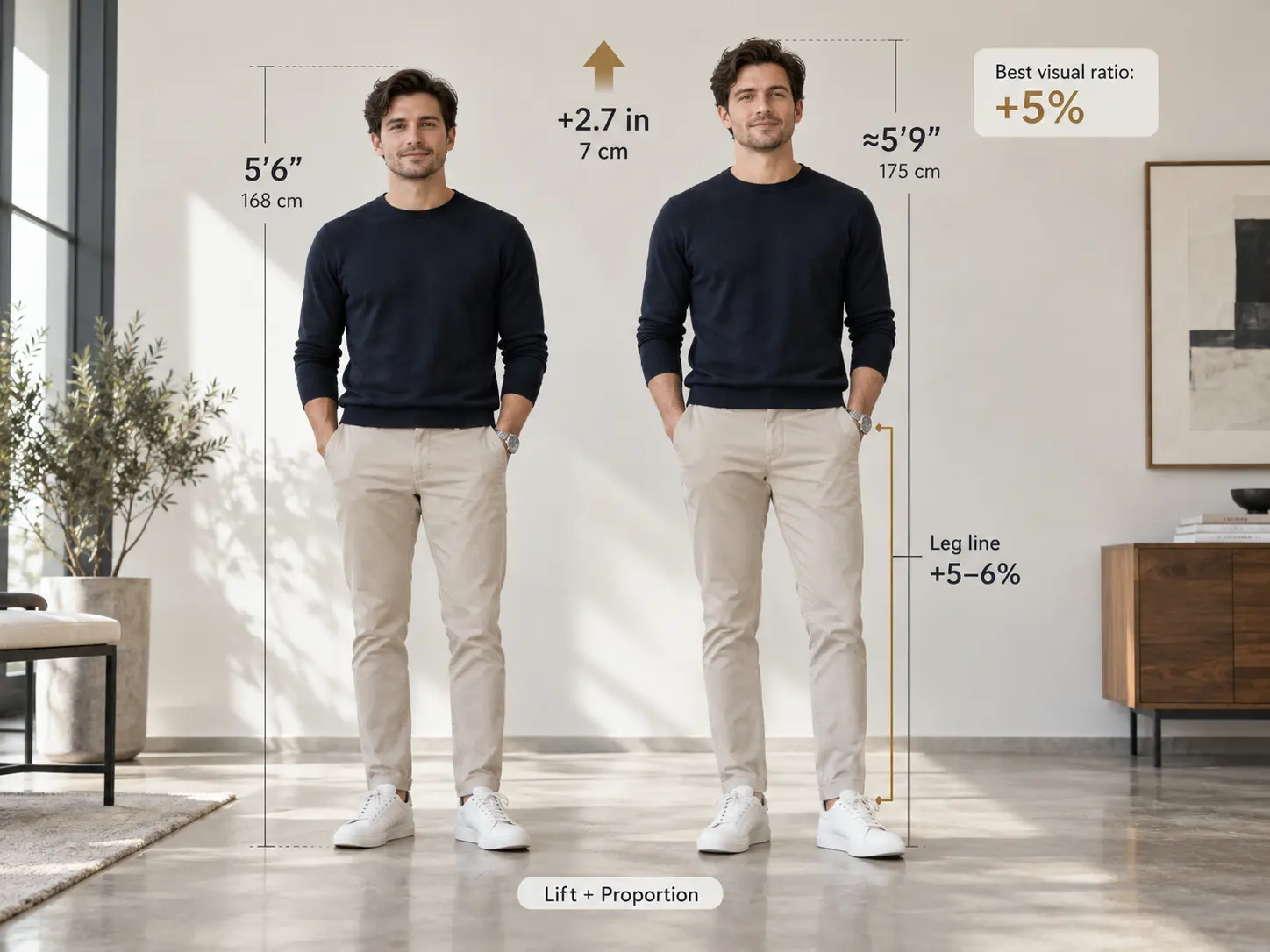
People judge your height by your proportions, not by a tape measure. Researchers Piotr Sorokowski and Boguslaw Pawlowski tested male body silhouettes in Evolution and Human Behavior and found that observers rated men as most attractive when their legs were 5% longer than the population average (ResearchGate | Ethology Text). A separate study in Royal Society Open Science confirmed that viewers rely on limb-to-body ratios as their primary cue when judging male stature (NCBI PMC5990728).
Here is how the math works in practice. If you stand 5’6″ (66 inches), your lower body measures roughly 31 to 32 inches. Putting on a pair of 2.7-inch (7 cm) elevator shoes adds all of that height below your ankle bone. You reach nearly 5’9″, and you lengthen your leg line by 5% to 6%.
3. Footwear Comparison: Which Shoe Fits Your Goal?
Pick your footwear based on how much height you want, what trousers you wear, and how long you plan to stay on your feet.

| Shoe Style | Real Height Gain | Stealth Score | Who Should Buy This (Best For) |
|---|---|---|---|
| Built-In Elevator Dress Shoes | 2.4″ – 3.2″ (6 – 8 cm) | 9.5 / 10 | Office professionals, grooms, and executives who wear suits or dress slacks and want a sharp Oxford or Derby profile. |
| Formal Height-Boosting Dress Boots / Chelsea Boots | 2.4″ – 4.0″ (6 – 10 cm) | 9.5 / 10 | Men seeking maximum lift (3″+) without detection. The higher boot shaft hides the steeper foot angle underneath long pants. |
| Built-In Elevator Sneakers | 2.0″ – 2.8″ (5 – 7 cm) | 9.0 / 10 | Commuters, travelers, and casual dressers who walk 8,000+ steps a day and want cushioned arch support. |
| Chunky / Lug-Sole Boots & Sneakers | 1.5″ – 2.0″ (3.8 – 5 cm) | 6.5 / 10 | Younger men and streetwear fans who don’t mind a thick, visible rubber outsole on jeans or cargo pants. |
| Standard Goodyear-Welted Dress Shoes | 1.0″ – 1.25″ (2.5 – 3.2 cm) | 10 / 10 | Men who only want a subtle 1-inch boost from a traditional stacked leather heel. |
| Minimalist Low-Top Sneakers / Loafers | 0.5″ – 0.8″ (1.3 – 2 cm) | 10 / 10 | Summer wear with shorts. Low-cut collars expose your ankle bone so your calves look longer. |
| Regular Shoes + Loose Heel Inserts | 0.8″ – 1.5″ (2 – 3.8 cm) | 4.5 / 10 | Short, 2-hour photo shoots only. Not recommended for walking due to heel slippage and toe crowding. |
Shop by Heiht:
- +5 CM / 2.0″
- +6 CM / 2.4″
- +7 CM / 2.8″
- +8 CM / 3.1″
- +9 CM / 3.5″
- +10 CM / 4.0″
- +11 CM / 4.3″
- +12 CM / 4.7″
- +13 CM / 5.1″
- +14 CM / 5.5″
- +15 CM / 5.9″
4. Five Footwear & Tailoring Rules That Add Instant Height
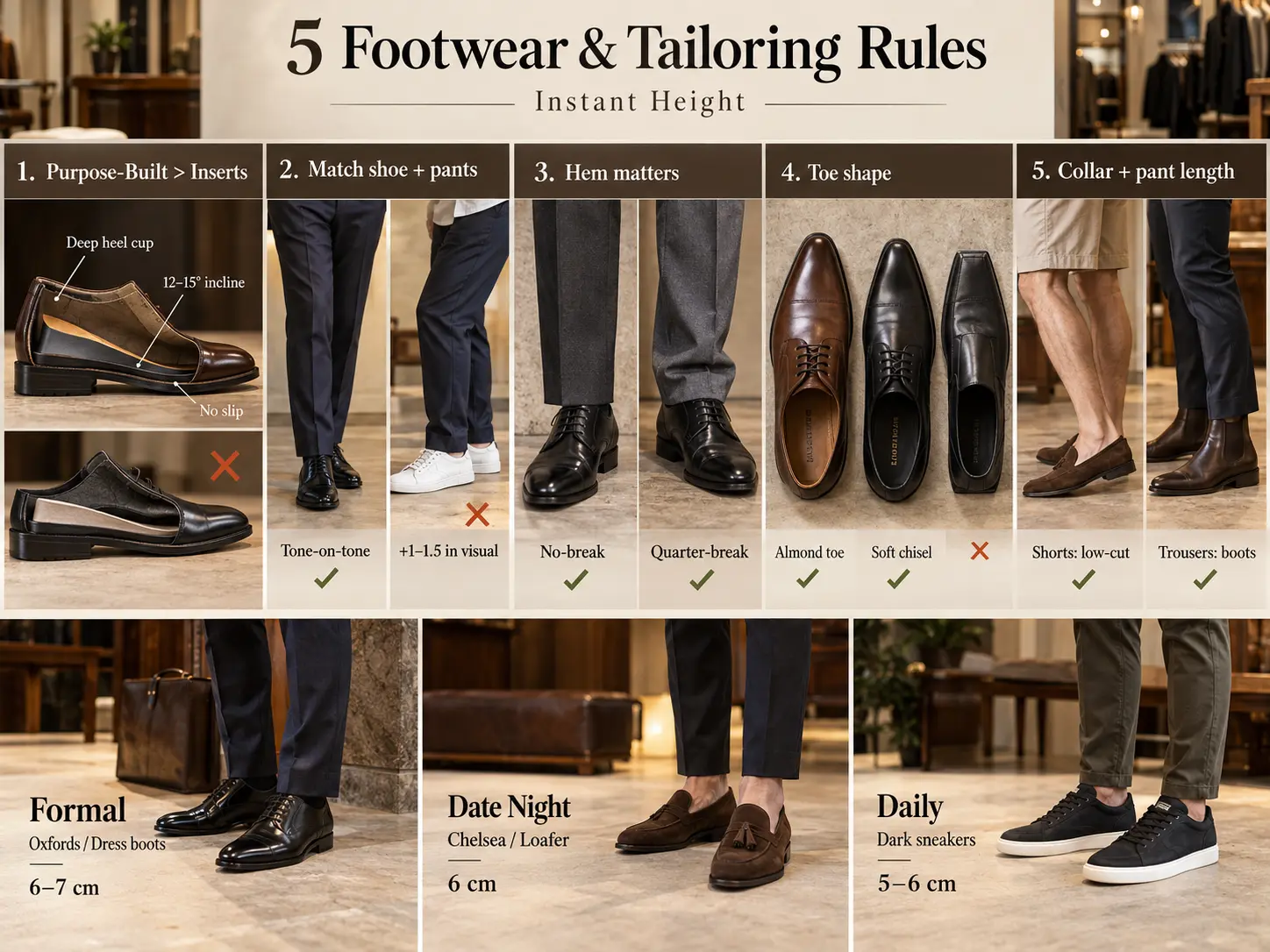
Rule 1: Wear Purpose-Built Elevator Shoes Instead of Loose Inserts
Buy shoes engineered around an internal lift rather than stuffing foam wedges into regular shoes.
Standard shoes have a shallow heel counter (the stiff cup at the back of the shoe that holds your heel in place). Dropping a 1.5-inch silicone insert into a regular shoe pushes your heel above that cup. Your heel slips out with every step, and your toes jam into the vamp (the front leather section covering the top of your foot).
Loose inserts also hurt your feet over time. A biomechanical study in Frontiers in Bioengineering and Biotechnology used 3D musculoskeletal modeling to show that unengineered heel elevation shifts heavy stress onto the plantar fascia (the thick ligament connecting your heel to your toes) and forefoot joints (NCBI PMC8720874). Clinical gait data in Sensors confirms that your foot needs full-arch contact to spread weight evenly while walking (NCBI PMC3444133).
What to look for when buying: Choose a purpose-built elevator shoe with a full-length anatomical incline sloped at 12 to 15 degrees. Externally, the heel measures a standard 1.1 to 1.25 inches, while the deepened leather upper keeps your ankle locked comfortably inside the shoe.
Rule 2: Match Your Shoe Color to Your Pants
Wear shoes that match the color—or at least the darkness—of your trousers.
When you wear dark navy jeans with bright white sneakers, you draw a sharp horizontal line across your ankles. Vision scientists Peter Thompson and Kyriaki Mikellidou at the University of York (i-Perception) proved that sharp visual boundaries distort how observers judge human body length (PubMed: PMID 23145226). A high-contrast shoe stops the viewer’s eye at your ankle.
How to pair them:
- Black or charcoal pants: Wear black calfskin Oxfords, black Chelsea boots, or all-black leather sneakers.
- Navy or dark indigo pants: Wear dark brown, oxblood, or dark navy footwear.
- Khaki or tan chinos: Wear medium-brown suede loafers or desert boots.
Keeping the color tone consistent from belt to toe creates one unbroken column, adding 1 to 1.5 inches of visual height.
Rule 3: Tailor Your Pants to a “No-Break” or “Quarter-Break” Hem
Ask your tailor for a no-break or quarter-break hem so your pant legs don’t bunch up over your shoes.
A pant break is the horizontal crease that forms where the bottom of your trouser leg rests on the top of your shoe. Heavy fabric folds around your ankles make your legs look shorter and wider.
- For low-cut dress shoes and sneakers: Ask for a no-break hem. The bottom cuff should barely touch the top of your shoe leather when you stand straight.
- For formal height-boosting dress boots: Ask for a quarter-break hem with a 6.5- to 7-inch flat leg opening. The pant leg will rest smoothly over the top of the boot, hiding the elevated instep even when you walk or sit down.
Rule 4: Pick an Almond or Softly Chiseled Toe
Choose shoes with an almond toe (a gently rounded, slightly tapered tip) or a softly chiseled toe.
Shoe length needs to stay proportional to your height:
- Skip long, pointy shoes: Overly pointed toes make your feet look too long for your legs, reminding people that your frame is compact.
- Skip boxy square or round toes: Wide, blunt toes add horizontal bulk at the floor and make you look stocky.
- Choose almond toes: They extend your foot line by a clean 0.5 inches without looking oversized.
Rule 5: Match the Shoe Collar to Your Pant Length
Show your ankle bone when wearing shorts, and cover your ankle with boots when wearing long pants.
- With summer shorts: High-top sneakers cover the narrowest part of your lower leg and cut your calf in half visually. Wear low-cut loafers, boat shoes, or low-profile elevator sneakers with no-show socks. Exposing your ankle bone makes your legs look longer.
- With trousers and jeans: Wear formal height-boosting dress boots or Chelsea boots. Because your pant legs cover the ankle shaft, a boot can easily house a 2.8- to 3.2-inch (7 to 8 cm) internal lift without anyone seeing the steeper foot angle.
5. Quick Outfit Formulas by Occasion

1. Business Suits, Weddings & Formal Events
- What to wear: Black cap-toe elevator Oxfords or black calfskin formal height-boosting dress boots.
- Target lift: 2.4″ to 2.8″ (6 to 7 cm).
- How to style it: Wear a charcoal or midnight-navy suit with a two-button jacket and tailored trousers (quarter-break hem). Keep your socks the exact same color as your pants.
2. Date Night & Smart Casual Office
- What to wear: Dark brown suede elevator Chelsea boots or dark brown leather loafers.
- Target lift: 2.4″ (6 cm).
- How to style it: Pair with slim-tapered dark indigo jeans. Never roll or cuff the bottom of your jeans—a turned-up denim cuff creates a bright horizontal stripe that shortens your legs.
3. Daily Commuting, Travel & Weekends
- What to wear: All-black or all-navy leather elevator sneakers with a hidden internal wedge and EVA foam cushioning.
- Target lift: 2.0″ to 2.4″ (5 to 6 cm).
- How to style it: Pair with tapered black chinos or dark athletic joggers. Avoid sneakers with bright white soles if you are wearing dark pants.
6. Frequently Asked Questions (FAQ)
Can people tell if you are wearing elevator shoes?
No, provided you stick to a 2.0- to 2.8-inch (5 to 7 cm) lift in low-cut shoes and hem your pants properly. Purpose-built elevator shoes hide the lift inside a deepened leather upper while keeping the outside heel at a normal 1.1-inch height. If you want 3.0 inches (7.5 cm) or more, wear boots so your trouser legs cover the higher ankle angle.
How much height do elevator shoes add compared to regular shoes?
Elevator shoes give you a 1.5- to 2.75-inch net height advantage over standard footwear. Flat canvas sneakers only add 0.5 to 0.7 inches (1.3 to 1.8 cm), and traditional dress shoes add 1.0 to 1.25 inches (2.5 to 3.2 cm). Built-in height-increasing shoes add 2.0 to 5.0 inches (5 to 12 cm) total.
Can you walk all day in elevator shoes without foot pain?
Yes, if the shoe uses a full-length internal incline with built-in arch support. Unlike loose half-insoles that crush your toes and strain your heel, a full-length polyether or cork lift supports your entire foot from heel to ball. For heavy walking days (over 8,000 steps), pick a 2.0- to 2.4-inch (5 to 6 cm) elevator sneaker or boot.
References
- U.S. Centers for Disease Control and Prevention (CDC) — National Center for Health Statistics (NCHS): FastStats: Body Measurements (Anthropometric Reference Data for Children and Adults: United States). View Source
- Judge, T. A., & Cable, D. M. (2004): The Effect of Physical Height on Workplace Success and Income: Preliminary Test of a Theoretical Model. Journal of Applied Psychology, 89(3), 428–441. PubMed | APA Summary
- Stulp, G., Buunk, A. P., & Pollet, T. V. (2013): Women want taller men more than men want shorter women. Personality and Individual Differences, 54(8), 877–883. Full Study PDF
- Sorokowski, P., & Pawlowski, B. (2008): Adaptive preferences for leg length in a potential partner. Evolution and Human Behavior, 29(2), 86–91. ResearchGate
- Versluys, T. M. M., Foley, R. A., & Skylark, W. J. (2018): The influence of leg-to-body ratio, arm-to-body ratio and intra-limb ratio on male human attractiveness. Royal Society Open Science, 5(5), 171790. NCBI PMC
- Thompson, P., & Mikellidou, K. (2011): Applying the Helmholtz illusion to fashion: horizontal stripes won’t make you look fatter. i-Perception, 2(1), 69–76. PubMed
- Wang, M., Li, S., Teo, E.-C., Fekete, G., & Gu, Y. (2021): The Influence of Heel Height on Strain Variation of Plantar Fascia During High Heel Shoes Walking-Combined Musculoskeletal Modeling and Finite Element Analysis. Frontiers in Bioengineering and Biotechnology, 9, 791238. NCBI PMC
- Abdul Razak, A. H., Zayegh, A., Begg, R. K., & Wahab, Y. (2012): Foot Plantar Pressure Measurement System: A Review. Sensors, 12(7), 9884–9912. NCBI PMC