Stretching cannot make your bones grow longer or increase your permanent skeletal height.
However, it can help you appear 1–2 inches (2.5–5 cm) taller by correcting posture, decompressing the spine, and helping you stand at your full natural height.
Here’s what the science actually says.
Table of Contents
- What Actually Determines Your Height?
- The Role of Growth Plates: Why Adults Can’t “Grow” Taller
- The Diurnal Height Cycle: You’re Already Taller in the Morning
- How Stretching Actually Affects Your Height
- Posture: The Hidden Height You’re Losing Every Day
- 7 Best Stretches to Maximize Your Height Potential
- What About Yoga and Pilates?
- What Actually Helps You Grow Taller (For Teens Still Growing)
- Common Myths Debunked
- Final Verdict
- References
1. What Actually Determines Your Height?
Before diving into whether stretching can make you taller, let’s understand what controls height in the first place.

Genetics: The #1 Factor (~80%)
Your DNA is the single most important factor in determining how tall you’ll be. According to research published by MedlinePlus (National Library of Medicine), genetics accounts for approximately 80% of the variation in height within a population — meaning the overwhelming majority of your adult stature is inherited from your parents.
Height is a polygenic trait, meaning it is influenced by thousands of small genetic variants rather than one single gene.
— Harvard Medical School
Environment: The Other ~20%
The remaining 20% comes from environmental factors during your growth years:
- Nutrition (protein, calcium, vitamin D, zinc)
- Sleep quality (growth hormone is released during deep sleep)
- Physical activity
- Overall health (chronic illness can limit growth)
- Socioeconomic factors (access to healthcare and nutrition)
[!IMPORTANT] This “80/20 split” refers to population-level variation. It does NOT mean 80% of your specific height is genetic. In populations with poor nutrition, the environmental contribution can be much higher — studies have found heritability of height as low as 46% in resource-limited settings.
Sources:
- MedlinePlus — Is height determined by genetics?
- NIH / PubMed Central — Heritability of height in different populations
2. The Role of Growth Plates: Why Adults Can’t “Grow” Taller

What Are Growth Plates?
Growth plates (also called epiphyseal plates) are areas of cartilage located near the ends of long bones in children and adolescents. These are the zones where new bone tissue is produced, enabling bones to lengthen during growth.
When Do They Close?
| Gender | Typical Closure Age | Notes |
|---|---|---|
| Females | 13–16 years | Usually 1–2 years after first menstrual period |
| Males | 15–19 years | Most reach peak height by 16–18; some grow slightly into early 20s |
Once the growth plates ossify (harden into solid bone), no amount of stretching, exercise, supplements, or dietary changes can increase bone length. This is a fundamental biological fact.
Once the growth plates have fused, activities such as exercise, stretching, or dietary changes will not increase your bone length.
— Cleveland Clinic
The most reliable way to check whether growth plates are still open is a bone age X-ray of the hand and wrist.
Sources:
- Cleveland Clinic — When Do You Stop Growing?
- KidsHealth — Growth Plate Injuries
- Duke Health — Growth Plate Fractures
3. The Diurnal Height Cycle: You’re Already Taller in the Morning
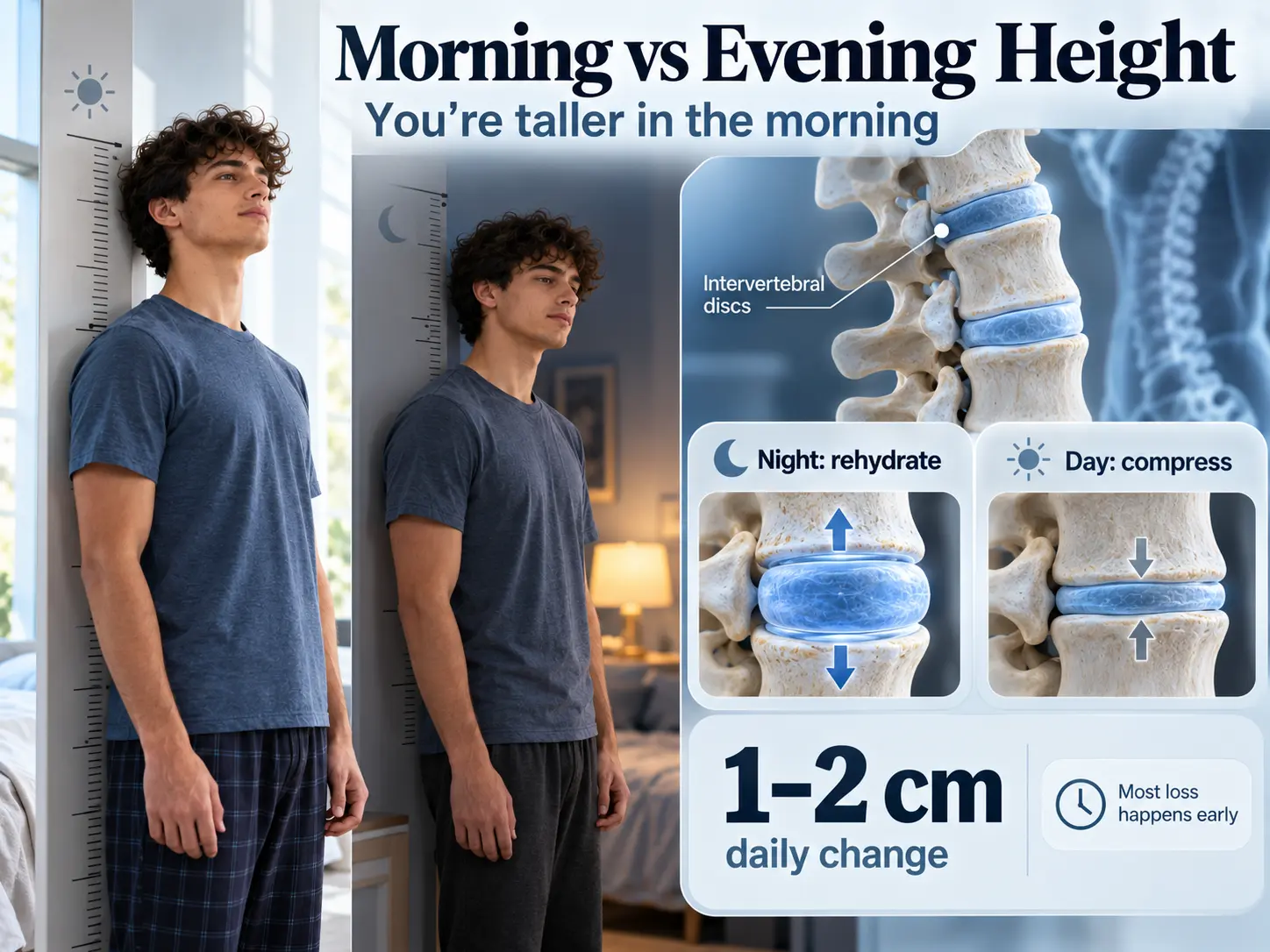
Here’s a fascinating fact that most people don’t know: you are measurably taller when you wake up than when you go to bed.
The Science
Throughout the day, gravity and physical activity compress the intervertebral discs (the soft, gel-like cushions between your vertebrae). These discs gradually lose fluid under load, causing them to flatten slightly.
When you lie down to sleep, the gravitational load is removed. The discs rehydrate by absorbing fluid from surrounding tissues, expanding back to their full thickness.
How Much Height Do You Lose?
| Finding | Amount | Source |
|---|---|---|
| Average daily height variation | 1–2 cm (0.4–0.8 inches) | Multiple studies |
| Peak-to-trough variation | ~19.3 mm (~1.9 cm) | Tyrrell et al., 1985 |
| Height loss in first hour of standing | 50–54% of total daily loss | Reilly et al., 1984 |
| Height loss in first 3 hours | Up to 80% of total daily loss | Tyrrell et al., 1985 |
[!TIP] If you want to measure your “true” height, do it first thing in the morning before getting out of bed. For consistent tracking, always measure at the same time of day.
Sources:
- Tyrrell AR, Reilly T, Troup JDG. Circadian variation in stature and the effects of spinal loading. Spine. 1985;10(2):161-164. PubMed
- Reilly T, Tyrrell A, Troup JDG. Circadian variation in human stature. Chronobiol Int. 1984;1(2):121-126. PubMed
4. How Stretching Actually Affects Your Height
Now that we understand the basics, let’s address the core question directly.
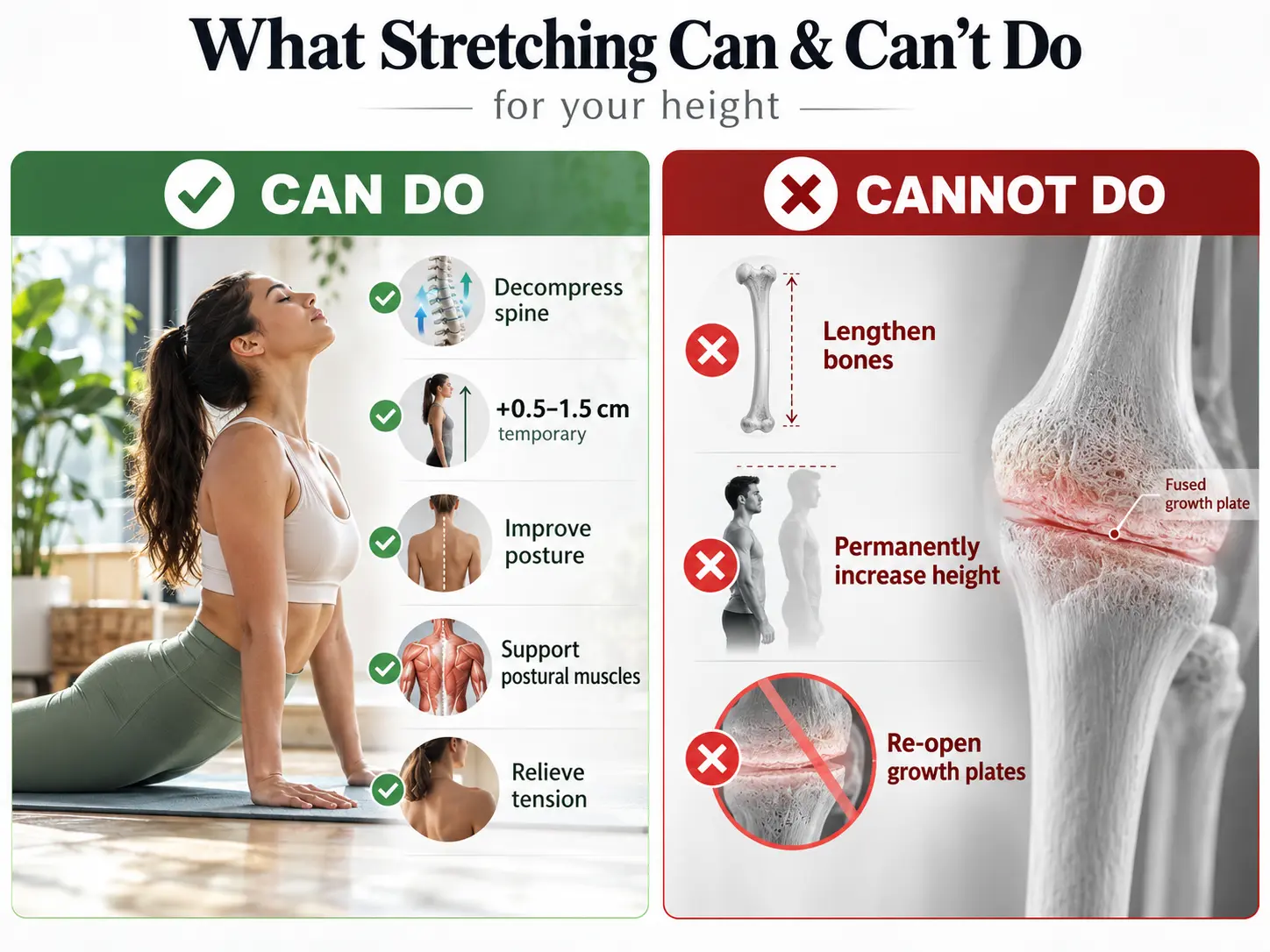
What Stretching CAN Do ✅
- Decompress the spine — Stretching can reverse the gravitational compression accumulated during the day, temporarily restoring ~0.5–1.5 cm of “lost” height. This is a real, measurable effect — but it’s the same height you had when you woke up.
- Correct postural deviations — Tight chest muscles, hip flexors, and hamstrings pull your body into misaligned positions (rounded shoulders, forward head, anterior pelvic tilt). Stretching releases these tight muscles, allowing your skeleton to stack more efficiently.
- Strengthen postural muscles — Dynamic stretching and exercises like yoga engage the core, erector spinae, and rhomboids, which support an upright posture.
- Relieve muscle tension — Chronic tension in the neck, shoulders, and lower back causes “protective slouching.” Releasing this tension lets you stand naturally taller.
What Stretching CANNOT Do ❌
- ❌ Lengthen bones — No exercise can make bones grow longer after growth plate closure.
- ❌ Permanently increase skeletal height — The effects of spinal decompression via stretching are temporary and reverse when you resume upright activities.
- ❌ Re-open closed growth plates — Once ossified, growth plates cannot be reactivated.
Brief periods of hyperextension or stretching can cause a measurable, temporary increase in height. This is due to the temporary decompression of the spine and does not represent permanent bone growth.
— National Institutes of Health (NIH)
Sources:
- NIH/PubMed Central — Effects of spinal loading and exercise on stature
- Cleveland Clinic — Can You Increase Your Height?
5. Posture: The Hidden Height You’re Losing Every Day
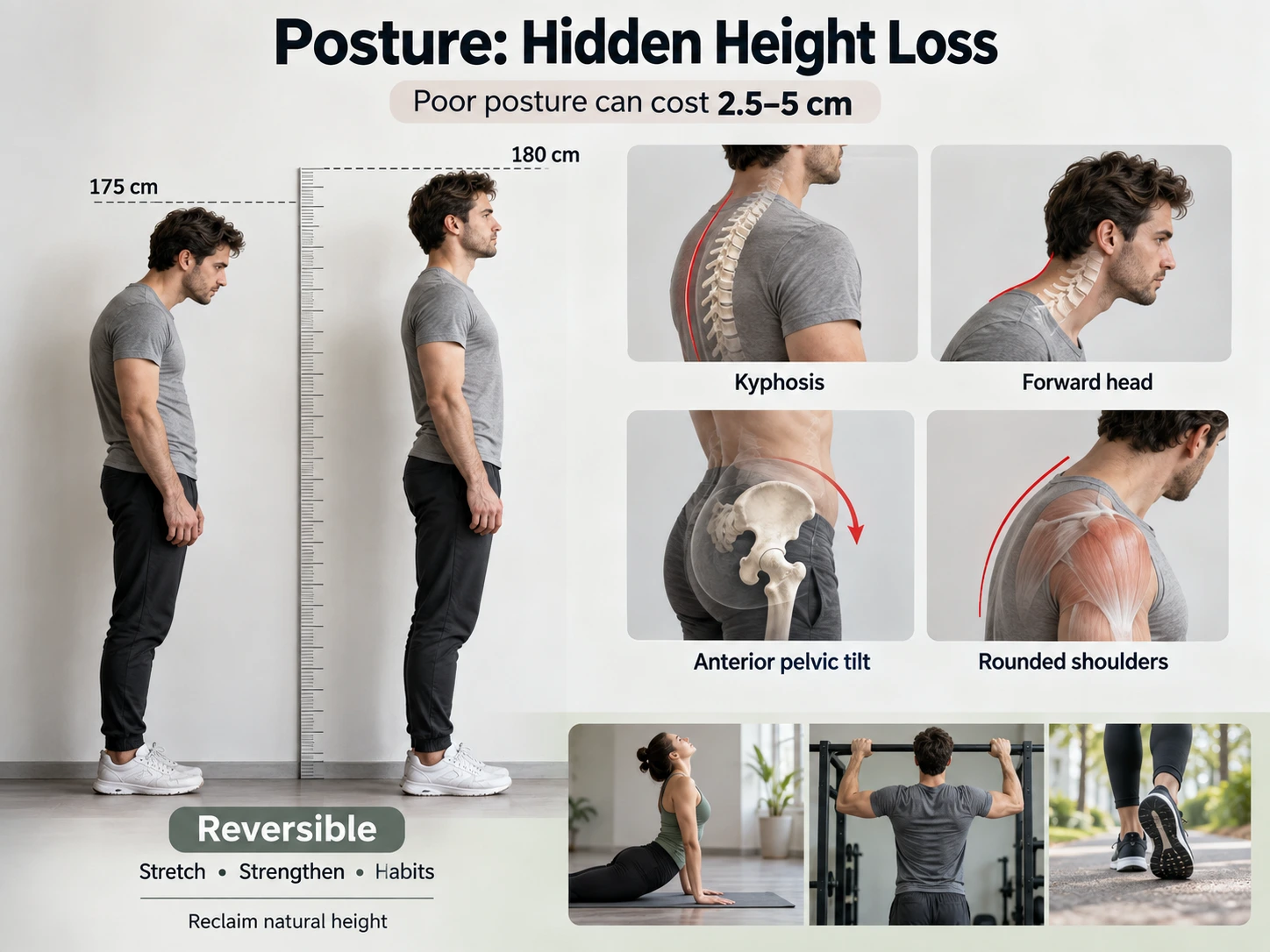
This is perhaps the most underappreciated aspect of the height discussion. Poor posture can rob you of 1–2 inches (2.5–5 cm) of your natural standing height.
Common Postural Problems That Steal Height
| Postural Issue | Height Loss Potential | Description |
|---|---|---|
| Thoracic kyphosis (upper back rounding) | Up to 1–2 inches | “Hunchback” posture from desk work |
| Forward head posture | 0.5–1 inch | Head juts forward, compressing cervical spine |
| Anterior pelvic tilt | Up to 1.4 inches (~3.5 cm) | Excessive lower back curve, common from prolonged sitting |
| Rounded shoulders | 0.5–1 inch | Tight chest muscles pull shoulders forward |
The Good News
Unlike bone growth, postural height loss is largely reversible. By correcting these misalignments through stretching, strengthening, and conscious habit changes, you can reclaim your full natural height.
Correcting poor posture can help you regain 1 to 2 inches of height.
— Harvard Health Publishing
Sources:
6. 7 Best Stretches to Maximize Your Height Potential
These stretches won’t make your bones longer, but they will help you stand at your full natural height by decompressing the spine and correcting posture.
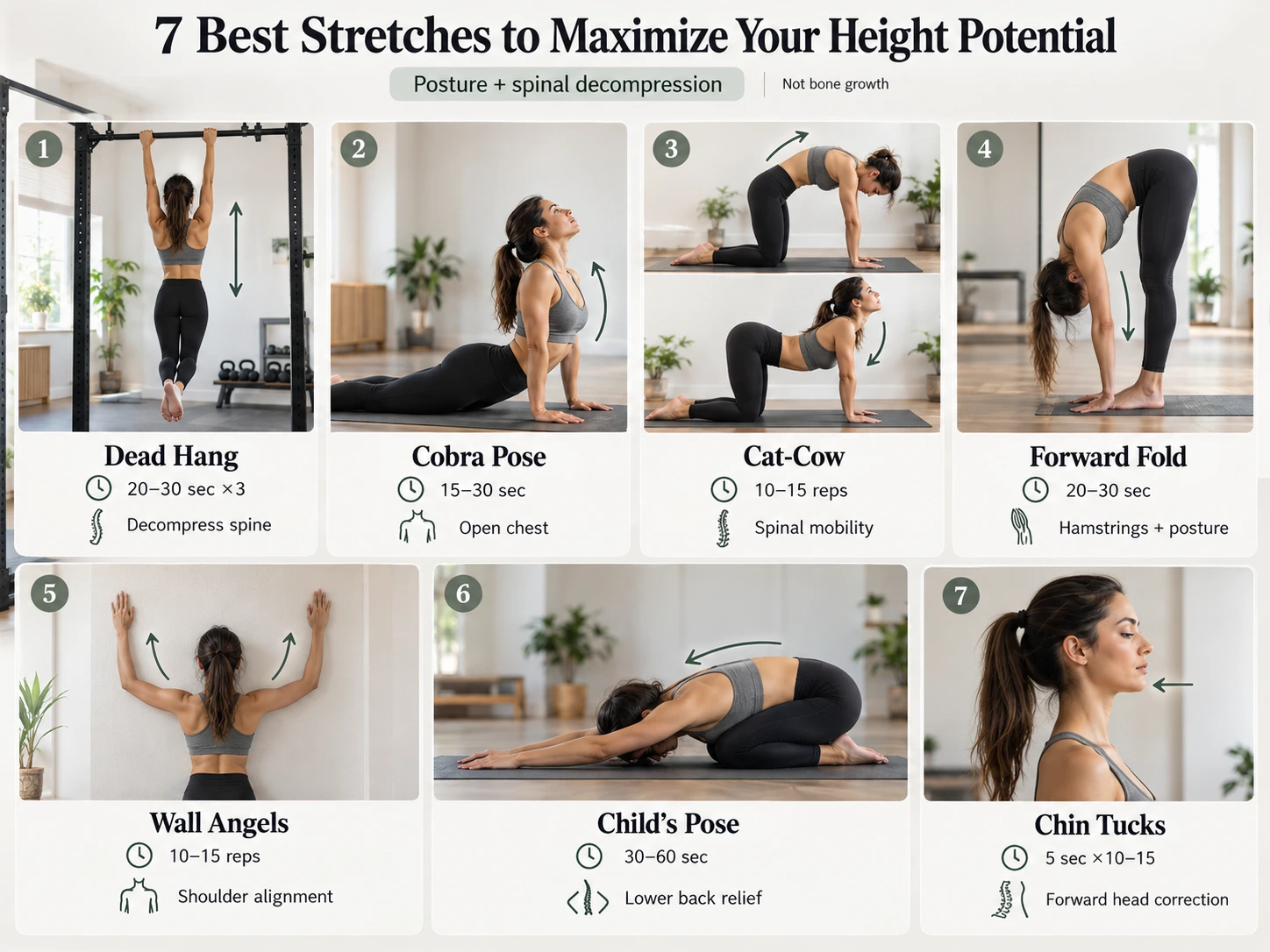
1. Dead Hang (Spinal Decompression)
Target: Full spinal decompression, shoulder mobility, grip strength
How to do it:
- Grip an overhead bar with both hands, shoulder-width apart
- Let your body hang freely with feet off the ground
- Relax your shoulders and let gravity stretch your spine
- Hold for 20–30 seconds, repeat 3 times
Why it works: Your body weight creates traction that separates the vertebrae and allows intervertebral discs to rehydrate. This can temporarily restore 0.5–1 cm of compressed height.
2. Cobra Pose (Bhujangasana)
Target: Spinal extension, chest opening, erector spinae strengthening
How to do it:
- Lie face down, palms under shoulders
- Press up, lifting your chest while keeping hips on the ground
- Arch your back gently, look slightly upward
- Hold for 15–30 seconds, repeat 3–5 times
Why it works: Directly counteracts the flexion-dominant posture (slouching) caused by desk work. Strengthens the posterior chain muscles that hold your spine upright.
3. Cat-Cow Stretch
Target: Full spinal mobility, tension release
How to do it:
- Start on hands and knees in tabletop position
- Cow: Inhale, drop belly, lift head and tailbone
- Cat: Exhale, round spine, tuck chin and tailbone
- Alternate for 10–15 repetitions
Why it works: Mobilizes every segment of the spine, releases tension in the neck and shoulders, and engages the core muscles essential for maintaining upright posture.
4. Standing Forward Fold
Target: Hamstring flexibility, spinal elongation
How to do it:
- Stand with feet hip-width apart
- Hinge at hips and fold forward, letting arms hang toward the floor
- Let gravity pull your head and spine down gently
- Hold for 20–30 seconds
Why it works: Tight hamstrings pull on the pelvis, creating anterior pelvic tilt and reducing your standing height. Releasing them allows the pelvis to sit in a neutral position.
5. Wall Angels
Target: Shoulder alignment, upper back strengthening
How to do it:
- Stand with back flat against a wall, feet 6 inches from the wall
- Place arms against the wall in a “goal post” position (90° at elbows)
- Slowly slide arms up and down the wall while maintaining contact
- Repeat 10–15 times
Why it works: Trains the scapular muscles to retract and depress, directly correcting rounded shoulders and forward head posture — two of the biggest posture-related height thieves.
6. Child’s Pose (Balasana)
Target: Lower back release, hip flexor stretch, spinal elongation
How to do it:
- Kneel on the floor, sit back on heels
- Extend arms forward on the floor, lowering forehead to the ground
- Reach arms as far forward as comfortable
- Hold for 30–60 seconds
Why it works: Gently stretches the entire posterior chain and decompresses the lumbar spine, providing relief from the compression of prolonged sitting.
7. Chin Tucks
Target: Forward head posture correction
How to do it:
- Sit or stand with good posture
- Without tilting your head, pull your chin straight back (creating a “double chin”)
- Hold for 5 seconds, repeat 10–15 times
Why it works: Strengthens the deep cervical flexors and retrains the head to sit directly above the shoulders instead of jutting forward — a common postural fault that can “steal” up to 1 inch of height.
7. What About Yoga and Pilates?
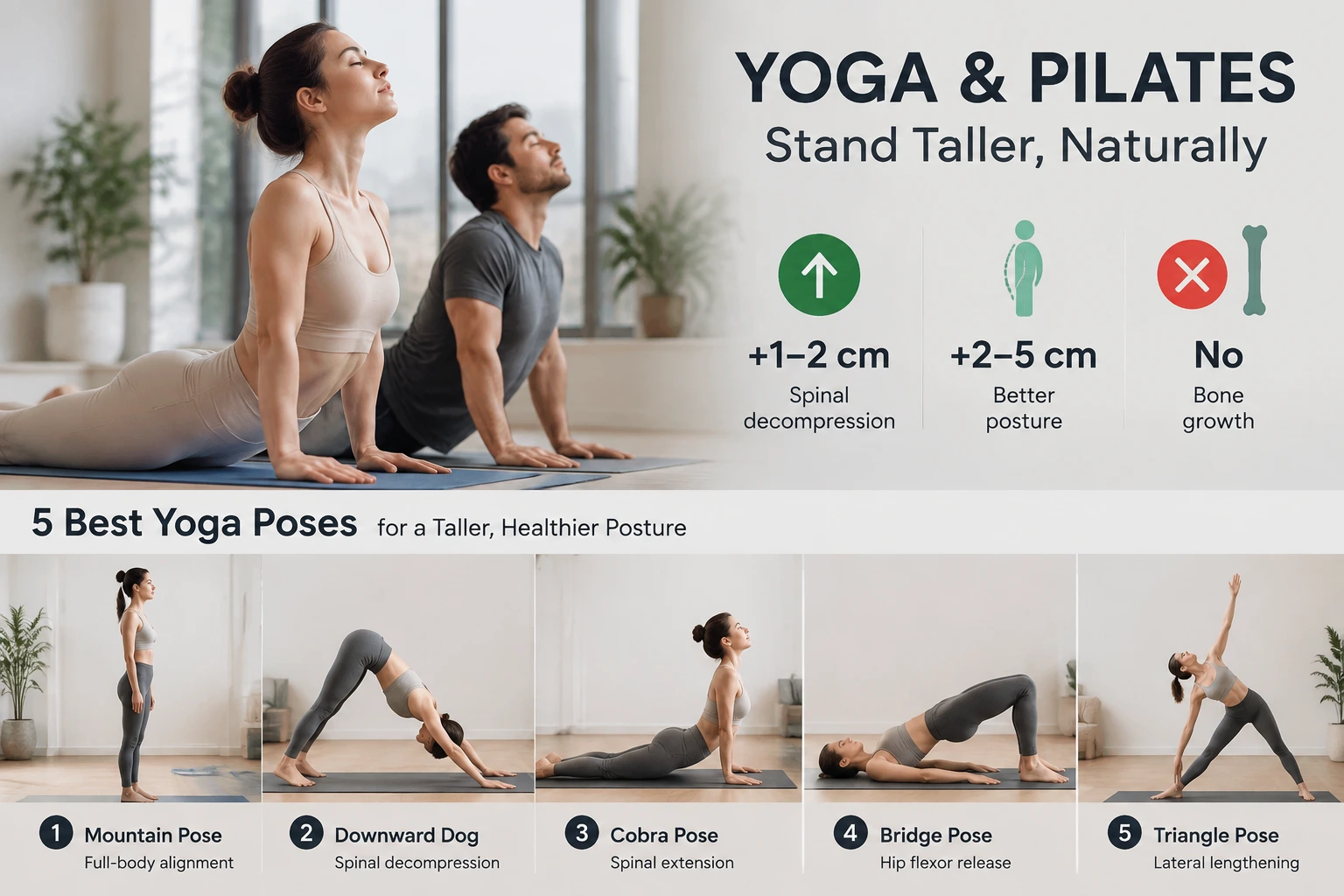
Yoga and Pilates are frequently cited as methods to “grow taller.” Let’s look at what the research actually says.
The Evidence
A study indexed in the National Library of Medicine (PubMed) found that regular yoga practice is effective at reducing thoracic kyphosis (the rounding of the upper back) and improving spinal alignment — both of which help you stand taller.
However, the same body of research is clear: yoga does not increase skeletal bone length. The height gains from yoga are entirely postural.
What Yoga Can Realistically Achieve
| Benefit | Mechanism | Evidence Level |
|---|---|---|
| Stand 1–2 cm taller | Spinal decompression | Well-supported |
| Appear 2–5 cm taller | Posture correction over weeks/months | Well-supported |
| Permanently grow taller | Bone lengthening | No evidence |
Best Yoga Poses for Height Optimization
- Mountain Pose (Tadasana) — Teaches optimal standing alignment
- Downward Dog (Adho Mukha Svanasana) — Full-body decompression
- Cobra Pose (Bhujangasana) — Spinal extension and chest opening
- Bridge Pose (Setu Bandhasana) — Hip flexor release, glute activation
- Triangle Pose (Trikonasana) — Lateral spinal lengthening
Sources:
8. What Actually Helps You Grow Taller (For Teens Still Growing)
If you’re a teenager or adolescent whose growth plates are still open, these are the evidence-based factors that genuinely influence your final height:

1. Nutrition 🥛
The most critical environmental factor for height growth.
| Nutrient | Role in Growth | Best Food Sources |
|---|---|---|
| Protein | Builds muscle and bone tissue | Eggs, lean meat, dairy, legumes |
| Calcium | Essential for bone mineralization | Milk, cheese, yogurt, leafy greens |
| Vitamin D | Helps the body absorb calcium | Sunlight, fortified milk, fatty fish |
| Zinc | Supports growth hormone function | Meat, shellfish, nuts, seeds |
Suboptimal nutrition and nutrient deficiencies can restrict growth and may lead to stunted stature.
— NIH/PubMed Central
2. Sleep 😴
Growth hormone (GH) is released primarily during deep sleep (stages 3 and 4 of non-REM sleep).
| Age Group | Recommended Sleep |
|---|---|
| 6–13 years | 9–11 hours |
| 14–17 years | 8–10 hours |
| 18–25 years | 7–9 hours |
— National Sleep Foundation
3. Physical Activity 🏃
Exercise stimulates the GH/IGF-1 axis (growth hormone/insulin-like growth factor 1), which is a key pathway for skeletal growth. [^10]
Best activities:
- Swimming — Full-body stretching in a low-gravity environment
- Basketball/Volleyball — Jumping stimulates growth plate activity
- Running/Cycling — Cardiovascular exercise supports overall health
- Resistance training — Contrary to myth, does NOT stunt growth when performed safely
4. Avoiding Growth Inhibitors ⚠️
- Chronic stress (elevates cortisol, which can suppress GH)
- Smoking/alcohol (directly toxic to growth plates)
- Chronic illness (unmanaged conditions divert resources from growth)
- Severe caloric restriction (crash diets during puberty)
Sources:
- NIH/PubMed — Nutrition and linear growth in children
- Unesp.br / PubMed — Physical activity and the GH/IGF-1 axis
- Healthline — How to Increase Your Height
9. Common Myths Debunked
| Myth | Reality | Source |
|---|---|---|
| “Stretching every day will make me grow 2 inches” | Stretching cannot lengthen bones. It can help you stand at your full natural height via posture correction. | Cleveland Clinic |
| “Hanging from a bar makes you permanently taller” | Hanging temporarily decompresses the spine (~0.5–1 cm), but the effect reverses within hours. | NIH/PubMed |
| “Growth hormone supplements make adults grow taller” | After growth plate closure, GH cannot increase bone length. In adults, excess GH causes acromegaly, not height increase. | Healthline |
| “Weight training stunts growth in teenagers” | Multiple studies confirm that properly supervised resistance training does not damage growth plates. | American Academy of Pediatrics |
| “You can reopen closed growth plates” | Once ossified, growth plates cannot be reactivated by any known method (exercise, diet, supplements, or medication). | KidsHealth / Nemours |
| “Sleeping more will make you taller” | Adequate sleep supports GH release, but sleeping extra hours won’t exceed your genetic potential. | KidsHealth |
10. Final Verdict
So, Does Stretching Make You Taller?
The short answer: No, but sort of yes.
- No — Stretching cannot increase your skeletal bone length. Once your growth plates close (typically by age 16–19), your bones will never grow longer, regardless of what you do.
- Sort of yes — Stretching can help you appear and measure up to 1–2 inches (2.5–5 cm) taller by:
- Decompressing the spine (temporary, ~0.5–1 cm)
- Correcting poor posture (semi-permanent with consistent practice, 1–5 cm)
- Releasing muscle tension that causes slouching
The Bottom Line
| If You Are… | What Stretching Can Do | Realistic Expectation |
|---|---|---|
| An adult | Maximize your natural height through posture | Gain 1–2 inches of apparent height |
| A teen (still growing) | Support healthy growth via flexibility and activity | Reach your full genetic potential |
| Anyone | Improve spinal health, reduce back pain, look more confident | Long-term quality-of-life benefits |
A Quick Styling Note: While stretching helps you maximize your natural frame over time, it won’t give you a dramatic increase. If you are looking for an instant, noticeable boost for a wedding, a job interview, or daily confidence, combining good posture with Chamaripa elevator shoes is the most effective strategy. They can safely and discreetly add 2–5 inches to your height without any waiting.
[!TIP] The most effective strategy isn’t a magic stretch — it’s a consistent daily routine combining stretching (5–10 min), core strengthening (10–15 min), and conscious posture awareness throughout the day. Over 4–8 weeks, most people notice a measurable difference.

References
- MedlinePlus (National Library of Medicine). “Is height determined by genetics?” https://medlineplus.gov/genetics/understanding/traits/height/
- Harvard Medical School. “Genetic variation and human height.” https://www.health.harvard.edu/
- Cleveland Clinic. “When Do You Stop Growing in Height?” https://health.clevelandclinic.org/when-do-you-stop-growing-in-height
- Tyrrell AR, Reilly T, Troup JDG. “Circadian variation in stature and the effects of spinal loading.” Spine. 1985;10(2):161-164. https://pubmed.ncbi.nlm.nih.gov/4002039/
- Reilly T, Tyrrell A, Troup JDG. “Circadian variation in human stature.” Chronobiology International. 1984;1(2):121-126. https://pubmed.ncbi.nlm.nih.gov/6600094/
- NIH/PubMed Central. Studies on spinal decompression and temporary height changes. https://www.ncbi.nlm.nih.gov/pmc/
- Harvard Health Publishing. “Why good posture matters.” https://www.health.harvard.edu/staying-healthy/why-good-posture-matters
- NIH/PubMed Central. Studies on yoga and spinal alignment improvement. https://www.ncbi.nlm.nih.gov/pmc/
- Healthline. “How to Increase Your Height: Is There Anything I Can Do?” https://www.healthline.com/nutrition/how-to-grow-taller
- KidsHealth / Nemours. “Growth Plates.” https://kidshealth.org/en/parents/growth-plates.html
- Osteoporosis Canada. “Height loss and bone health.” https://osteoporosis.ca/
- American Academy of Pediatrics. Position statement on youth resistance training safety. https://publications.aap.org/
Disclaimer: This article is for informational purposes only and does not constitute medical advice. If you have concerns about your height, growth, or spinal health, please consult a qualified healthcare professional.