Purpose-built elevator boots add 2.4 to 4.0 inches (6 to 10 cm) of hidden height, letting you match the long-legged cosplay without thick platform soles.
Many cosplayers try to reach a character’s 6’2″ (188 cm) stature by stuffing 2-inch foam pads into cheap vinyl costume boots. That shortcut fails within an hour on a convention floor.
Loose inserts push your heel above the back collar of the boot and jam your toes against the front leather.
A real elevator boot solves this by building the internal lift around a deepened shoe last (the 3D foot-shaped mold used to construct a boot).
Your ankle stays locked inside the leather shaft, and your arch gets full support across 10,000 steps on concrete.
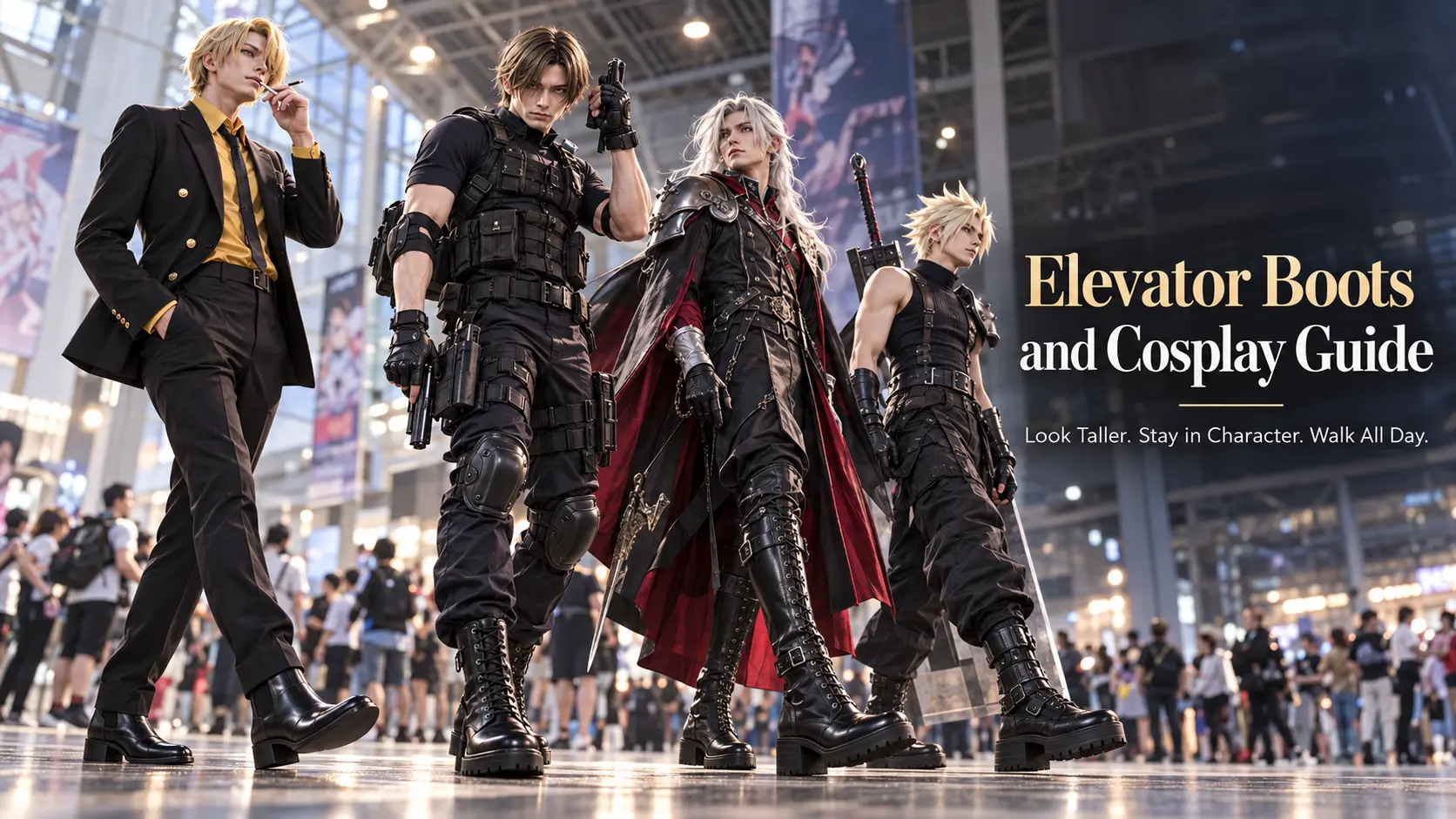
Quick Decision Summary (Pick by Character Build)
- Suit-Wearing Spy & Mafia Characters: Wear 2.8″ (7 cm) Black Calfskin Elevator Chelsea Boots under quarter-break dress slacks (fits Sanji, Loid Forger, or Albert Wesker).
- Tactical Soldiers & Armored Superheroes: Wear 3.2″–4.0″ (8–10 cm) Lace-Up Elevator Combat Boots with lugged rubber soles (fits Leon Kennedy, Captain America, or Cloud Strife).
- Medieval Knights & Fantasy Hunters: Wear 2.8″–3.2″ (7–8 cm) Dark Brown Leather Elevator Boots hidden beneath wrap-around leather gaiters (shin covers that buckle under the arch) for Geralt of Rivia or Alucard.
- Modern Shonen Uniforms: Wear 2.4″–2.8″ (6–7 cm) All-Black Leather Elevator Sneakers or Zip Boots matched to black slim trousers (fits Satoru Gojo or Sung Jinwoo).
The Proportion Math: Human Anatomy vs. 8-Head Character Design
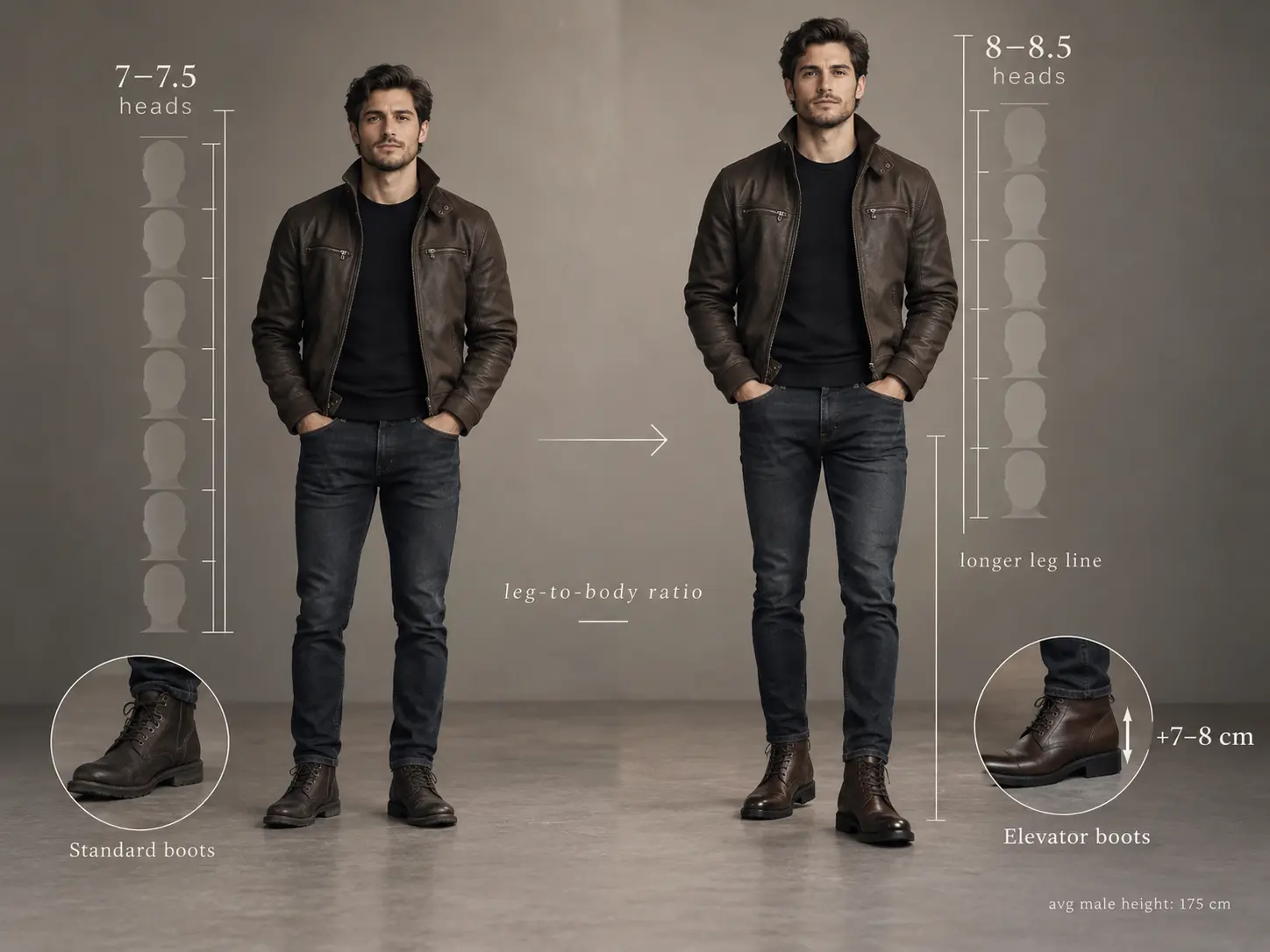
Adding 2.8 to 3.2 inches (7 to 8 cm) below your ankle closes the gap between real human proportions and stylized character art.
The average adult man in the United States stands 68.9 inches tall (nearly 5’9″ or 175 cm), based on physical measurement records from the U.S. Centers for Disease Control and Prevention (CDC) (CDC FastStats: Body Measurements). In classical figure drawing, a real human adult measures 7 to 7.5 heads tall. Comic book, manga, and video game leads are drawn at 8 to 8.5 heads tall (8-Head Proportion Canon).
Artists create that 8.5-head frame by drawing longer legs rather than a longer torso:
- The 5% Leg-Length Target: Researchers Piotr Sorokowski and Boguslaw Pawlowski published a study in Evolution and Human Behavior testing how leg length changes perceived attractiveness. Viewers rated male silhouettes highest when their legs measured 5% longer than the population average (ResearchGate).
- How Observers Judge Stature: A follow-up study in Royal Society Open Science confirmed that people rely on Leg-to-Body Ratio (how long your legs look compared to your torso) as their main visual cue when estimating male height (NCBI PMC5990728).
Spiked wigs, helmets, and foam shoulder armor make your head and upper torso look wider. That extra top bulk drops your visual ratio down toward 6.5 heads. Putting on a pair of 3.2-inch (8 cm) elevator boots adds all of the lift below your ankle bone, pushing your lower-body ratio up by 5% to 6% so your full-body photos match the character design.
Cosplay Footwear Comparison: Which Method Fits Your Build?
Choose your footwear setup based on how much height your character requires, whether your ankles are exposed, and how many hours you plan to walk at the venue.

| Footwear Setup | Real Height Gain | Photo Accuracy (Stealth Score) | 8-Hour Walkability | Who Should Use This (Best For) |
|---|---|---|---|---|
| Built-In Elevator Combat Boots | 3.2″ – 4.0″ (8 – 10 cm) | 9.0 / 10 (Looks like standard military tread) | High (Laced ankle support + full-arch slope) | Tactical soldiers, sci-fi troopers, and armored heroes carrying heavy prop rifles or shields. |
| Built-In Elevator Chelsea & Dress Boots | 2.4″ – 3.2″ (6 – 8 cm) | 9.5 / 10 (Hidden under suit pants) | Very High (Soft calfskin + cushioned footbed) | Suit-wearing anime characters, spies, and formal builds who also want to wear the boots to work or weddings after the convention. |
| Built-In Elevator Sneakers | 2.0″ – 2.8″ (5 – 7 cm) | 9.5 / 10 (Normal athletic outsole profile) | Maximum (Shock-absorbing foam midsole) | Streetwear, shonen uniform, and casual game characters walking 12,000+ steps across exhibition halls. |
| External Platform Boots (3″ Thick Soles) | 2.5″ – 4.5″ (6.3 – 11.4 cm) | 4.0 / 10 (Thick brick sole shows in photos) | Low (Heavy, rigid sole blocks natural toe bend) | Cyberpunk, gothic, or demon characters where a thick outsole matches the original artwork. |
| Regular Boots + Loose Silicone Inserts | 1.0″ – 1.8″ (2.5 – 4.5 cm) | 5.5 / 10 (Heel bulges out of top collar) | Poor (Crushes toes; slips during walking) | 30-minute indoor studio shoots only. Skip these for convention floors to avoid blisters and arch pain. |
Four Real-World Cosplay Samples Using Elevator Boots
1: Tailored Suit Characters (Sanji, Loid Forger, Albert Wesker)
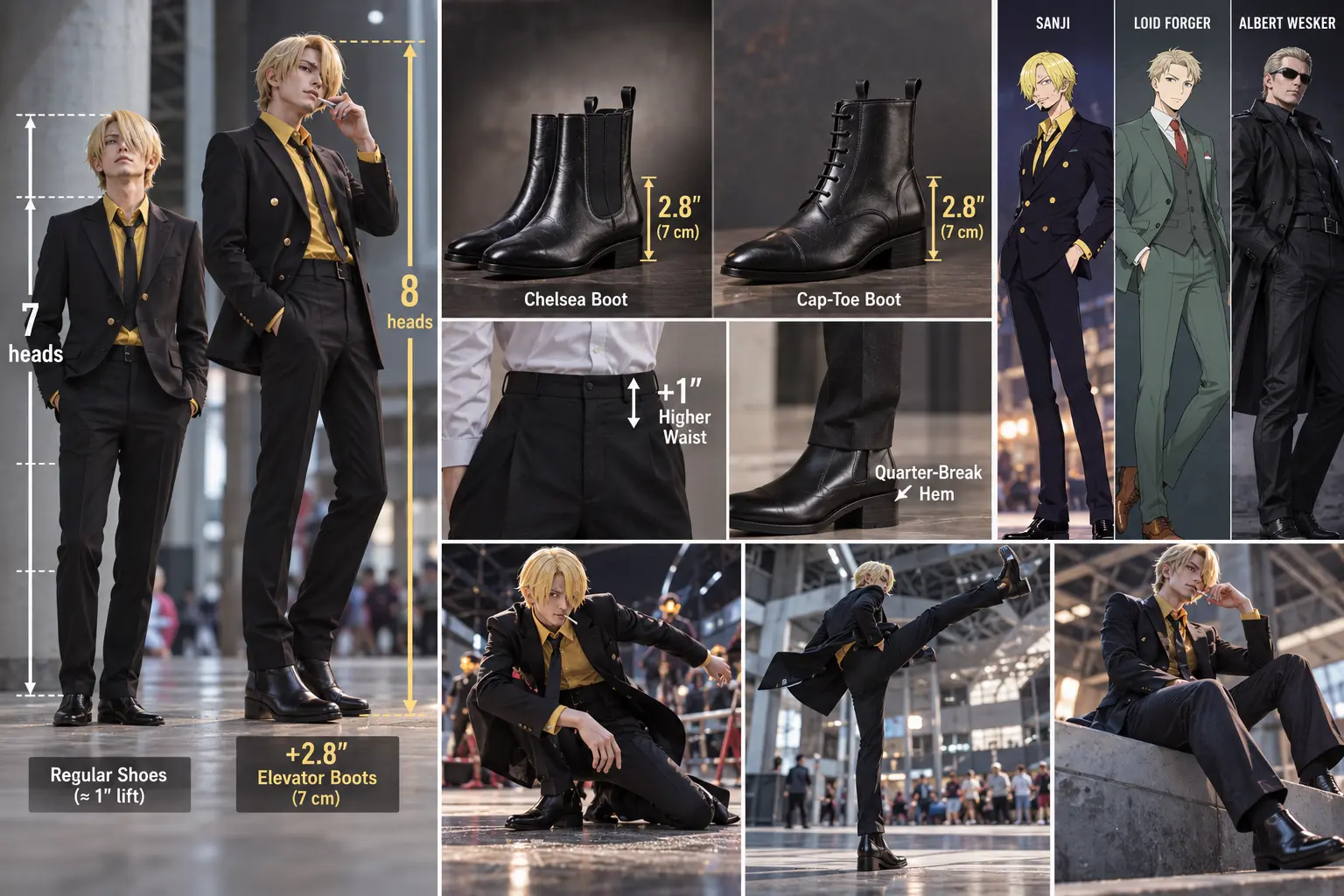
- The Proportion Problem: Anime characters in suits are drawn with legs that make up 55% of their total body height. Regular dress shoes only add 1 inch, which leaves suit pants looking short on camera.
- Boot Specification: 2.8-inch (7 cm) Black Calfskin Elevator Chelsea Boot or Cap-Toe Elevator Dress Boot with an almond toe.
- How to Build It: Tailor your suit pants to sit 1 inch higher on your waist and ask for a quarter-break hem (where the bottom cuff rests lightly on the front of the boot with just one slight crease). Because the leather boot shaft extends above your ankle bone, the 2.8-inch lift stays hidden under the pant leg even when you pose on stairs or throw a high kick.
- Real-World Value: After the weekend convention ends, you can wear the exact same full-grain calfskin boots with business suits or formal wedding attire.
2: Tactical & Armored Heroes (Leon Kennedy, Captain America, Cloud Strife)
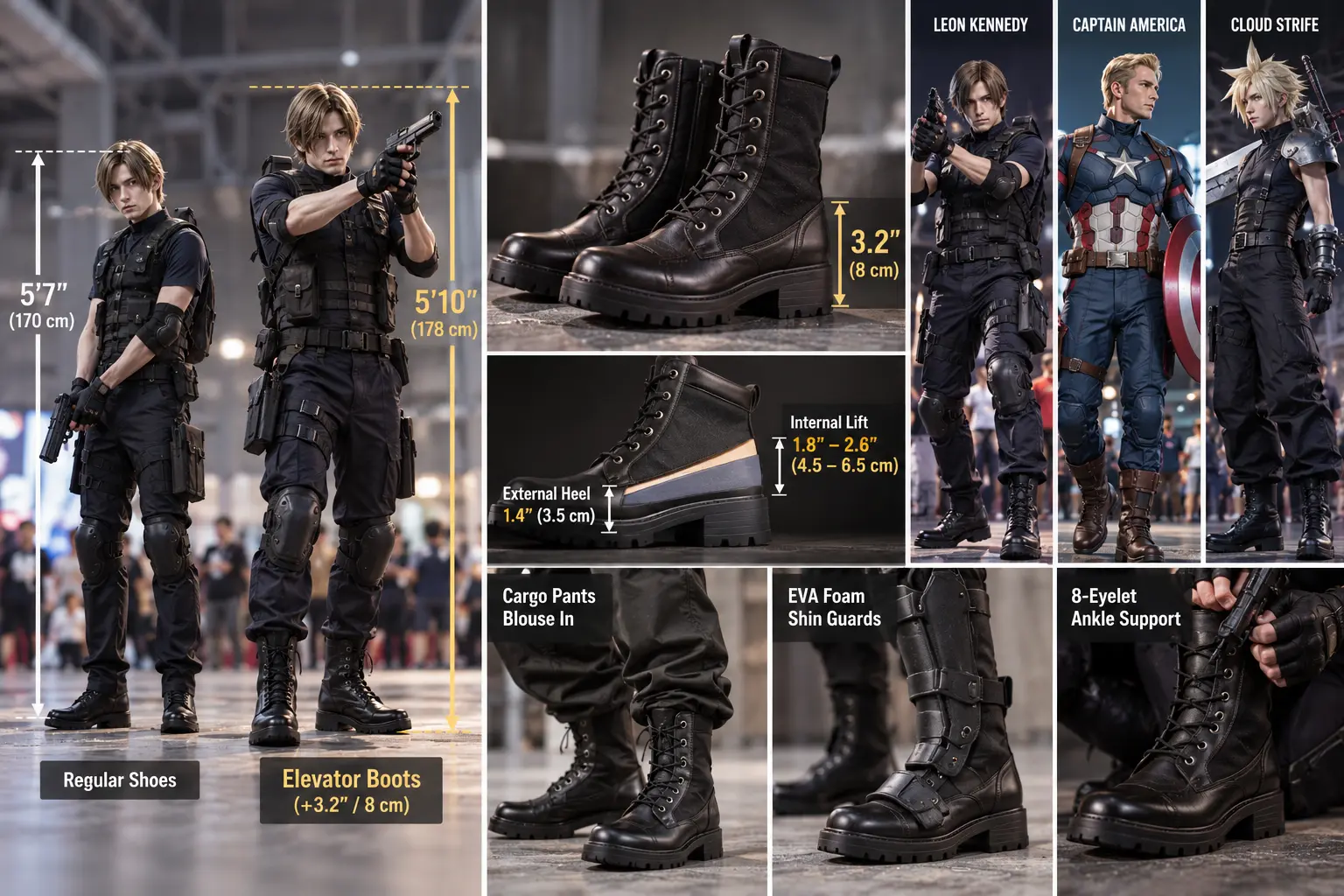
- The Proportion Problem: Tactical vests, ammo pouches, and foam chest plates add 2 to 3 inches of width to your upper body. Without extra leg length, chest armor makes a 5’7″ cosplayer look stocky.
- Boot Specification: 3.2-inch to 4.0-inch (8 to 10 cm) Black or Dark Brown Lace-Up Elevator Combat Boot with a lugged rubber outsole.
- How to Build It: Combat elevator boots split the lift between a 1.4-inch external rubber lug heel and a 1.8- to 2.6-inch internal wedge. Blouse your cargo pants into the top of the boot collar, or strap EVA foam (ethylene-vinyl acetate, a dense craft foam used to build cosplay armor) shin guards around the upper leather shaft.
- Ankle Support: The 8-eyelet lacing locks your ankle in place when you carry heavy 10-pound prop weapons.
3: Fantasy Knights & Vampires (Geralt of Rivia, Alucard, Doctor Strange)
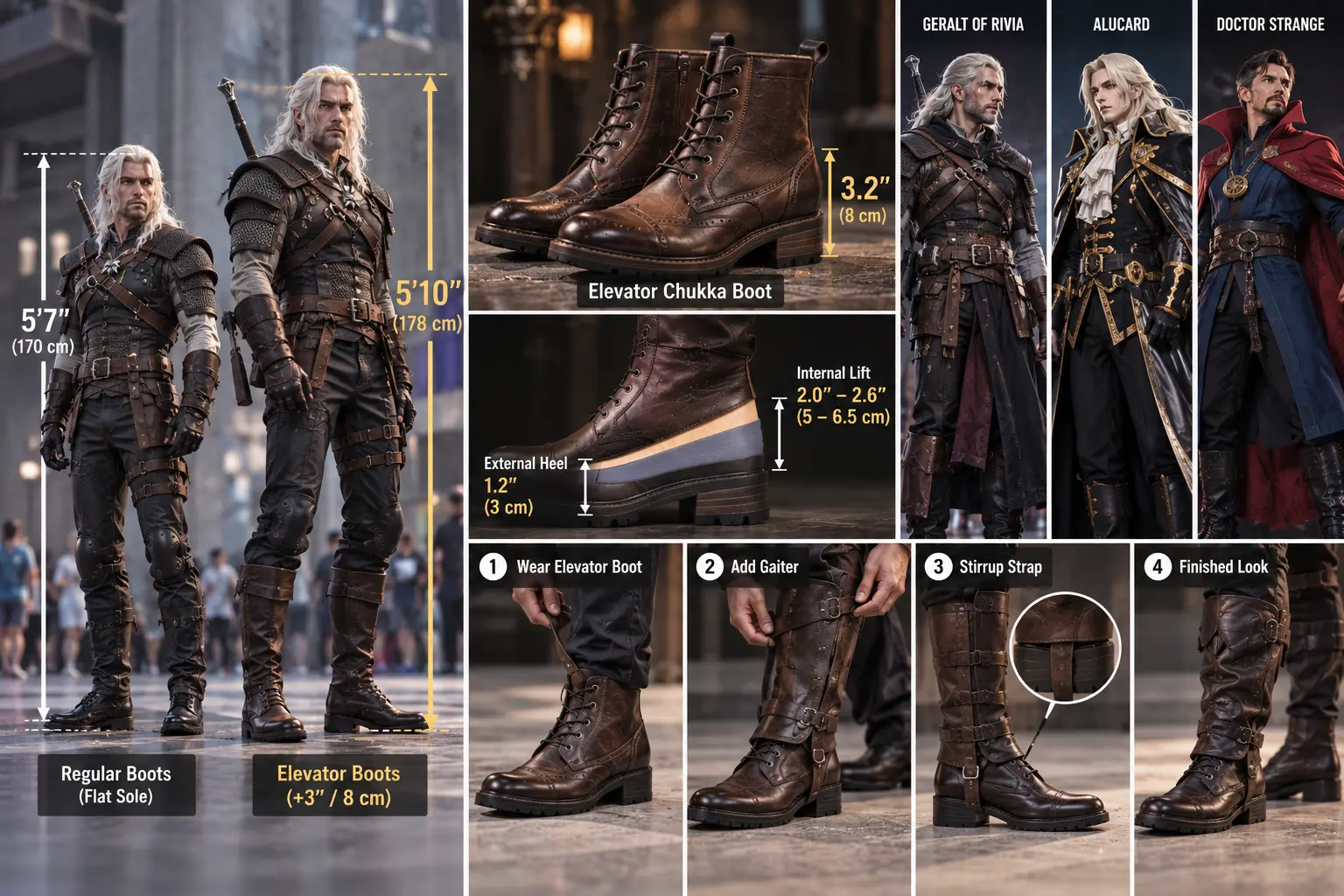
- The Proportion Problem: Knee-high riding boots sold by costume retailers use thin polyurethane (fake leather) with flat soles and zero arch support. Stuffing loose heel lifts inside thin costume boots causes the ankle fabric to sag and fold over.
- Boot Specification: 2.8-inch to 3.2-inch (7 to 8 cm) Dark Brown Leather Elevator Chukka or Brogue Boot paired with custom gaiters (tall leather or faux-leather shin covers that wrap around the calf and strap under the boot).
- How to Build It: Put on the genuine leather elevator boot first. Wrap your knee-high fantasy gaiter around your lower leg so the bottom edge covers the boot laces. Run a 1-inch elastic stirrup strap underneath the boot sole—right in front of the external heel block—to hold the gaiter down. On camera, it looks like a custom one-piece riding boot, while your feet get a 3-inch lift inside a real leather shoe last.
4: Modern Shonen Uniforms (Satoru Gojo, Sung Jinwoo, Persona Leads)

- The Proportion Problem: Modern anime leads wear slim dark uniforms with no bulky leg armor to disguise thick platform soles. Any external 2.5-inch platform brick stands out right away.
- Boot Specification: 2.4-inch to 2.8-inch (6 to 7 cm) All-Black Leather Elevator Sneaker or Minimalist Zip-Up Elevator Boot.
- How to Build It: Match black footwear with black slim-tapered uniform pants. Vision scientists Peter Thompson and Kyriaki Mikellidou at the University of York (i-Perception) showed that removing sharp horizontal color contrasts keeps the viewer’s eye moving up and down in one line. Wearing black elevator boots with black pants delivers 2.6 inches of real lift plus another 1 to 1.5 inches of visual height.
Convention Floor Biomechanics: Walking 8 Hours on Concrete
Skip loose silicone heel pads if you plan to stand and walk on concrete exhibition floors for more than two hours.
Researchers Thomas R. Waters and Robert B. Dick at the National Institute for Occupational Safety and Health (NIOSH / CDC) reviewed clinical standing data in Rehabilitation Nursing. They found that standing and walking slowly on hard floors for more than 2 to 4 hours increases lower-leg and lower-back pain by 4 to 6 times as blood pools in the calves.
Dropping an unengineered half-insole into a regular boot makes foot pain worse for two mechanical reasons:
- Plantar Fascia Strain: A 3D musculoskeletal modeling study by M. Wang and colleagues in Frontiers in Bioengineering and Biotechnology proved that unengineered heel elevation shifts joint pressure forward and strains the plantar fascia (the thick ligament band connecting your heel bone to your toes).
- Forefoot Pressure Spikes: Clinical gait data in Sensors shows that your foot needs continuous arch contact to spread body weight between the heel and ball while walking.
Follow these 3 steps to stay comfortable across a 3-day convention:
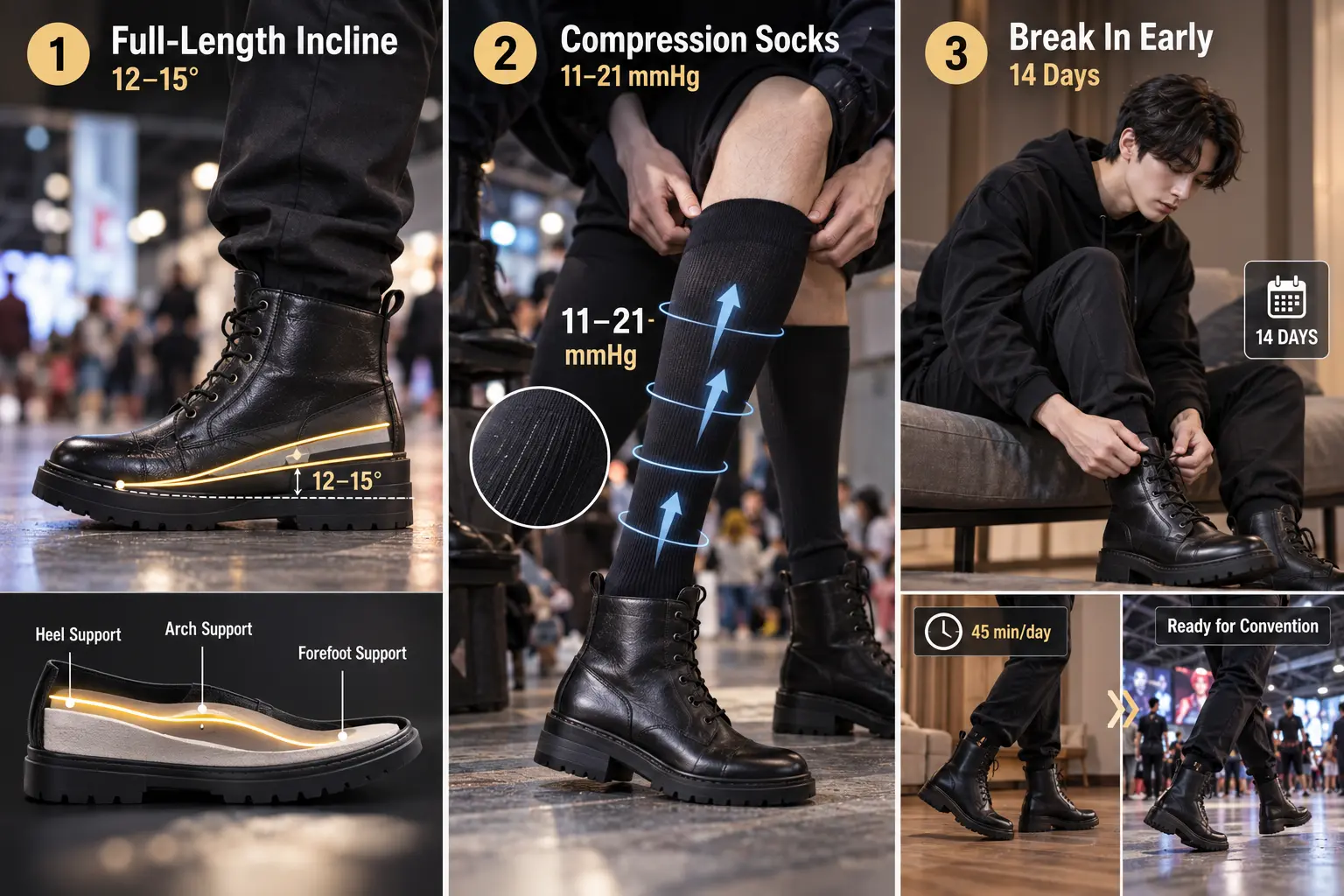
- Use a full-length 12-to-15-degree internal incline: Purpose-built elevator boots support your heel, arch, and forefoot across one continuous layer so you never feel tipped onto your toes.
- Wear 11–21 mmHg graduated compression socks: Clinical trials cited by NIOSH confirm that wearing knee-high compression socks rated at 11 to 21 mmHg (millimeters of mercury, the standard unit used to measure sock pressure) cuts down leg swelling and calf fatigue during 4+ hour standing shifts.
- Break in leather boots 14 days early: Wear your elevator boots indoors for 45 minutes a day for two weeks before the event so the leather upper softens across the top of your foot.
Three Armor & Camera Rules to Look Taller in Photos
- Rule 1: Anchor shin armor to the boot collar, not the floor. If rigid foam greaves (shin armor plates) rest directly on the rubber sole edge, they will scrape the concrete and push outward every time you bend your ankle. Leave a 0.75-inch gap above the sole and attach the inside of the shin guard to the top leather shaft of your elevator boot with Velcro strips.
- Rule 2: Go up 0.5 US size if adding thick socks or gel liners. Elevator boots come with a built-in cushioned footbed. If you wear thick merino wool socks or add a flat 3mm shock-absorbing liner for concrete halls, order half a size larger (0.5 US up) so your toes do not rub the front toe box.
- Rule 3: Ask photographers to shoot from belt height. When a standing photographer shoots from eye level, the camera points slightly downward and makes your legs look shorter. Ask the photographer to lower the camera lens to the height of your belt buckle and tilt slightly up. Pairing a belt-level camera angle with 3.2-inch elevator boots puts your full-body shot right at the 8.5-head mark.
FAQ
How much height can elevator boots add for cosplay without looking obvious?
Purpose-built elevator boots add 2.4 to 3.2 inches (6 to 8 cm) in dress and Chelsea styles, and up to 4.0 inches (10 cm) in lace-up combat boots, without looking like platform shoes. Because the lift sits inside a deepened leather upper covered by your pant leg or shin gaiter, only the standard 1.1- to 1.4-inch outside heel shows in photos.
Can you attach EVA foam armor or boot covers over elevator boots?
Yes, real leather elevator boots hold EVA foam armor much better than soft vinyl costume shoes. Attach Velcro strips, magnets, or elastic stirrup straps to the stiff leather ankle shaft and underneath the arch right in front of the heel block. Keep glue off the front flex crease of the boot so your foot can bend naturally when walking.
Are 3-inch elevator boots comfortable enough for an 8-hour comic convention?
Yes, if you pick a lace-up combat boot or Chelsea boot with a full-length anatomical incline and break them in for 14 days before the convention. On days when you expect to walk over 10,000 steps on concrete floors, pair a 2.4- to 2.8-inch (6 to 7 cm) elevator boot or sneaker with 15–20 mmHg compression socks to prevent calf fatigue.
References
- U.S. Centers for Disease Control and Prevention (CDC) — National Center for Health Statistics (NCHS): FastStats: Body Measurements (Anthropometric Reference Data for Children and Adults: United States). View CDC Source
- Waters, T. R., & Dick, R. B. (2015) — National Institute for Occupational Safety and Health (NIOSH): Evidence of Health Risks Associated with Prolonged Standing at Work and Intervention Effectiveness. Rehabilitation Nursing, 40(3), 148–165. NCBI PMC Full Text | PubMed
- Sorokowski, P., & Pawlowski, B. (2008): Adaptive preferences for leg length in a potential partner. Evolution and Human Behavior, 29(2), 86–91. ResearchGate
- Versluys, T. M. M., Foley, R. A., & Skylark, W. J. (2018): The influence of leg-to-body ratio, arm-to-body ratio and intra-limb ratio on male human attractiveness. Royal Society Open Science, 5(5), 171790. NCBI PMC
- Wang, M., Li, S., Teo, E.-C., Fekete, G., & Gu, Y. (2021): The Influence of Heel Height on Strain Variation of Plantar Fascia During High Heel Shoes Walking-Combined Musculoskeletal Modeling and Finite Element Analysis. Frontiers in Bioengineering and Biotechnology, 9, 791238. NCBI PMC
- Abdul Razak, A. H., Zayegh, A., Begg, R. K., & Wahab, Y. (2012): Foot Plantar Pressure Measurement System: A Review. Sensors, 12(7), 9884–9912. NCBI PMC
- Thompson, P., & Mikellidou, K. (2011): Applying the Helmholtz illusion to fashion: horizontal stripes won’t make you look fatter. i-Perception, 2(1), 69–76. PubMed
- Loomis, A. (1943) & Classical Atelier Canon: Figure Proportions: The 8-Head Canon vs. 8.5-Head Heroic Proportions in Visual Media. Artist Proportion Guide


