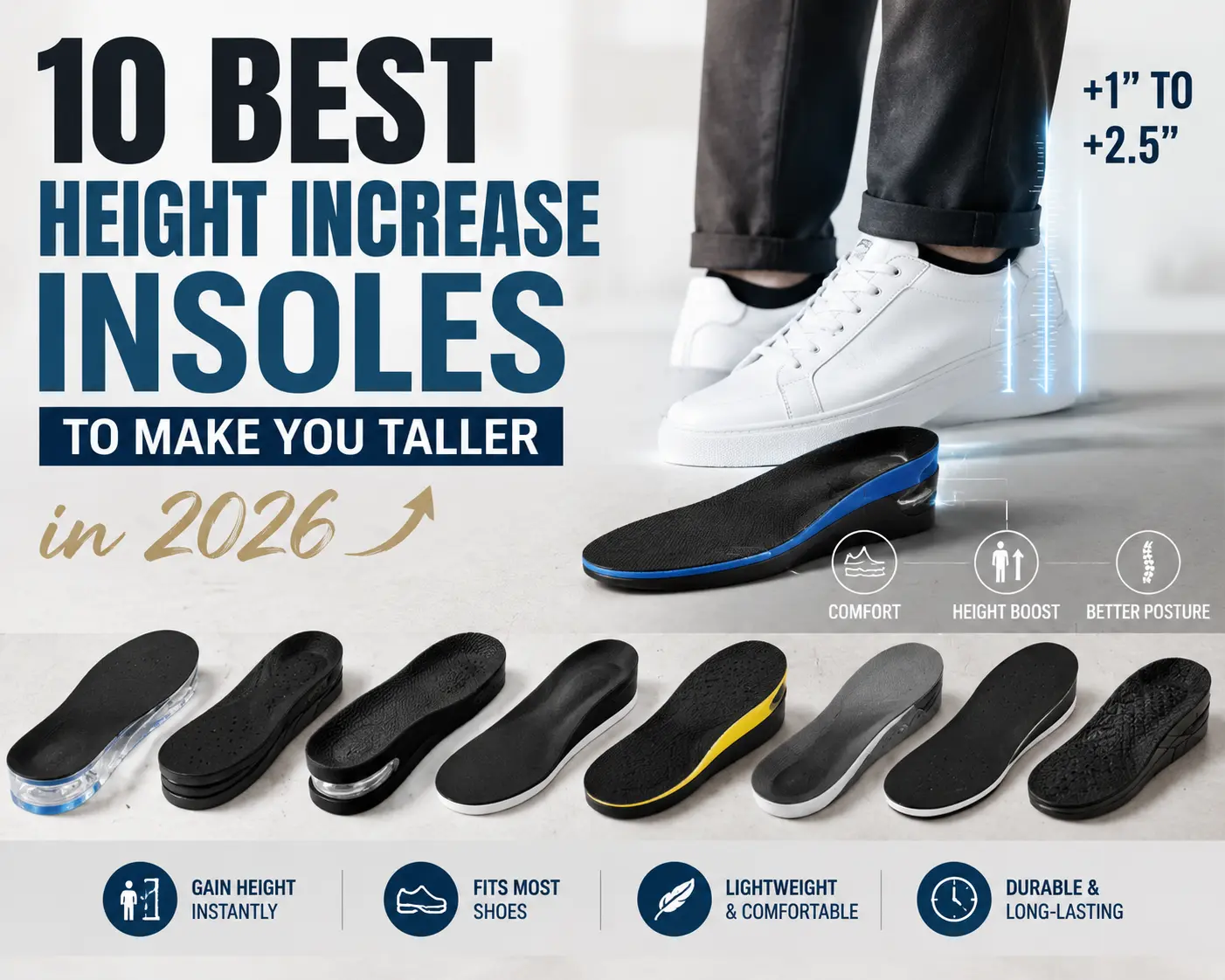
The best height increasing shoes should have an integrated lift (not a removable insert), a high-density PU or EVA midsole, proper arch support, a roomy toe box, and look indistinguishable from regular shoes.
Start with a 5 cm (2-inch) lift if you’re new.
This guide walks you through the 8 factors that matter most.
How Do Height Increasing Shoes Actually Work?
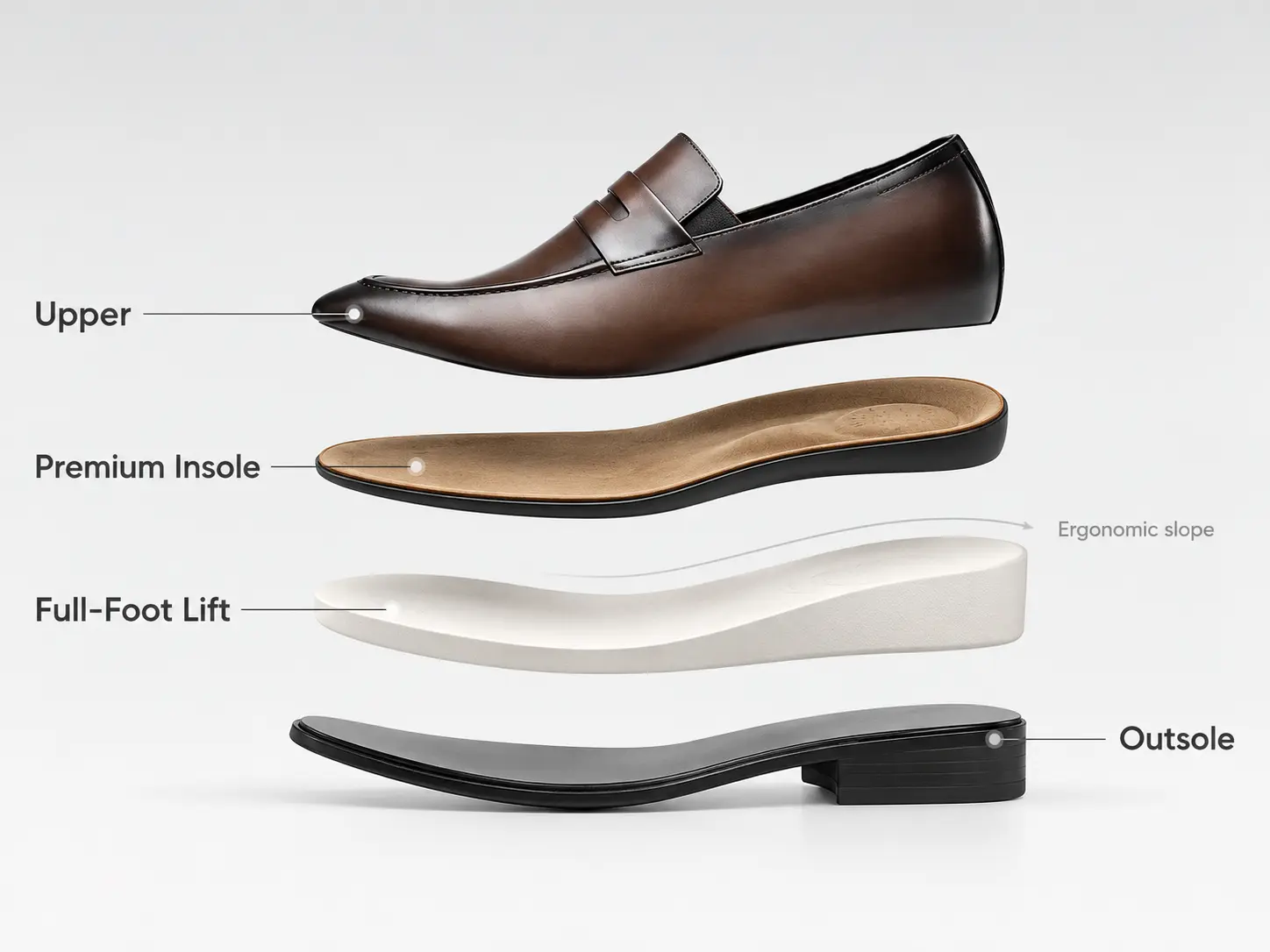
Height increasing shoes — commonly called elevator shoes — look like normal shoes on the outside but contain a hidden, elevated insole built into the shoe’s internal structure.
Unlike platforms or visible heels, the height boost is entirely concealed.
Here’s the anatomy:
| Component | What It Does |
|---|---|
| Hidden Lift (Internal Wedge) | The core — adds 2–13 cm of height |
| Ergonomic Footbed | Sits on top of the lift; provides cushioning and arch support |
| Heel Cup | Locks the heel in place at the elevated position |
| Upper | The visible exterior — leather, suede, or synthetic |
| Outsole | Bottom of the shoe; provides traction |
[!IMPORTANT]
The key difference between a quality elevator shoe and a cheap shoe with an insert stuffed inside is engineering. In a properly designed pair, the last (mold), heel counter, and toe box are all built to accommodate the extra internal height.
The 8 Things to Look for Before You Buy
1. Height — How Much Should You Choose?
| Height Increase | Best For | Comfort |
|---|---|---|
| 5-7 cm (2-2.8 in) | The “sweet spot” for most people | ⭐⭐⭐⭐⭐ |
| 8–10 cm (3.1–3.9 in) | Special occasions, boots only | ⭐⭐⭐⭐ |
| 10–15 cm (4–6 in) | Experienced users only | ⭐⭐⭐ |
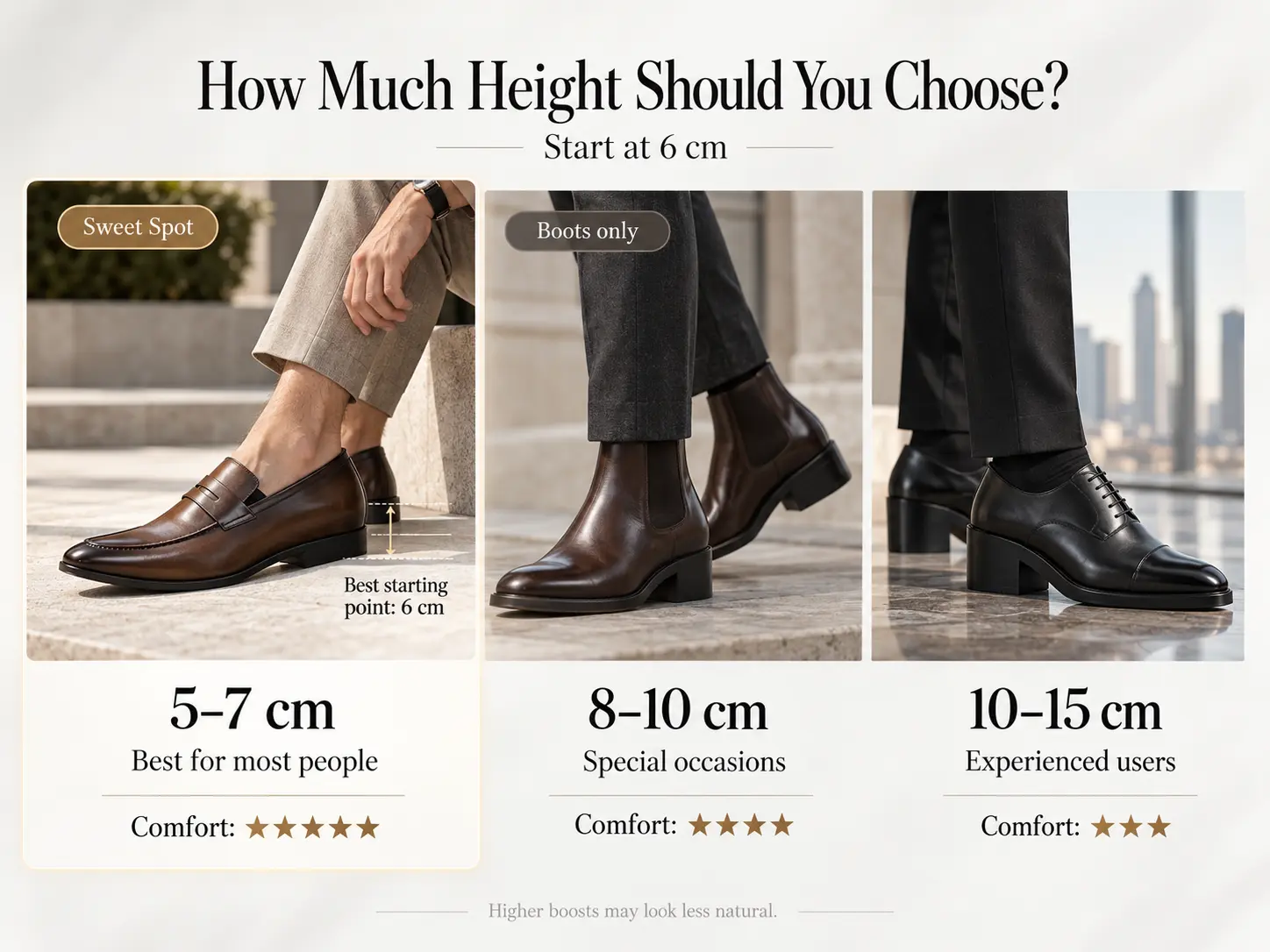
Start at 6 cm. Research shows that heel heights above 6 cm are associated with reduced stride length and altered ankle mechanics, which can make your walk look unnatural.
Also beware the “Half-Rule”: experienced users report that advertised heights are often optimistic. But Chamaripa claims Free Exchange for shoe height less than the description.
2. Internal Lift Material — The Most Important Spec
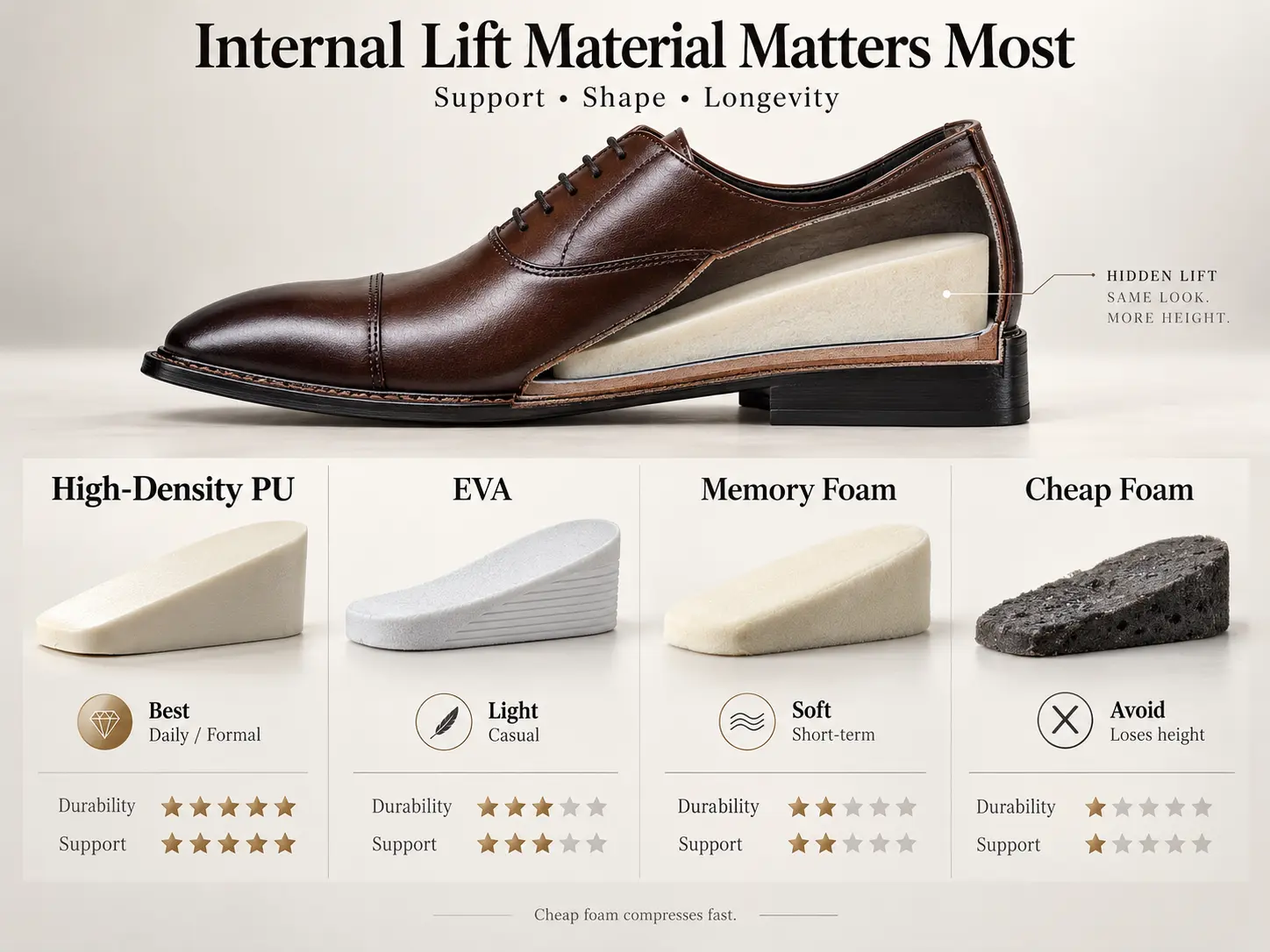
The lift material matters more than the brand name or leather type. It determines how long the shoe keeps its height and support:
| Material | Durability | Compression Resistance | Weight | Best For |
|---|---|---|---|---|
| High-density PU | ⭐⭐⭐⭐⭐ | ⭐⭐⭐⭐⭐ | Heavy | Formal/daily shoes — holds height long-term |
| EVA | ⭐⭐⭐ | ⭐⭐⭐ | Light | Casual sneakers — bouncy but compresses faster |
| Memory Foam | ⭐⭐ | ⭐⭐ | Light | Short-term wear only |
| Cheap Foam | ⭐ | ⭐ | Light | ❌ Avoid — loses height in weeks |
[!WARNING]
Cheap, low-density foam lifts compress within weeks, meaning you gradually lose the height boost AND the structural support. Always ask or check what the lift is made of.
3. Construction — Built-In vs. Insert
This is the single biggest differentiator between a quality elevator shoe and a gimmick.
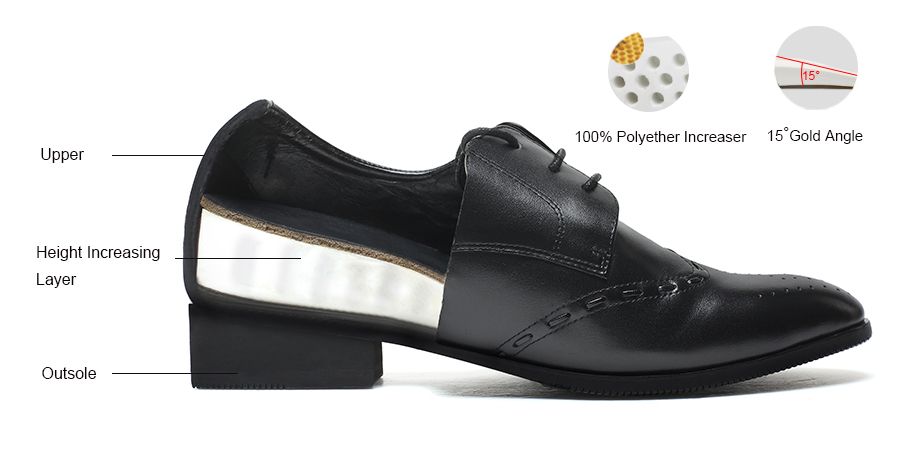
Built-In (Integrated) Lift ✅
- Shoe is designed from the ground up around the lift
- Weight distributed across the entire footbed
- Heel cup deep enough to secure your heel at the elevated position
Removable Insert in a Regular Shoe ❌
- Standard shoes aren’t designed for extra height
- Heel pops out, toes get cramped, arch support misaligned
- Unstable weight distribution increases injury risk
For dress shoes, look for Goodyear welted construction — it allows resoling, meaning a quality pair can last 5–10 years.
4. Arch Support & Ergonomics
Without proper arch support, the elevated angle dumps excessive pressure onto the ball of your foot, leading to pain and fatigue within hours.
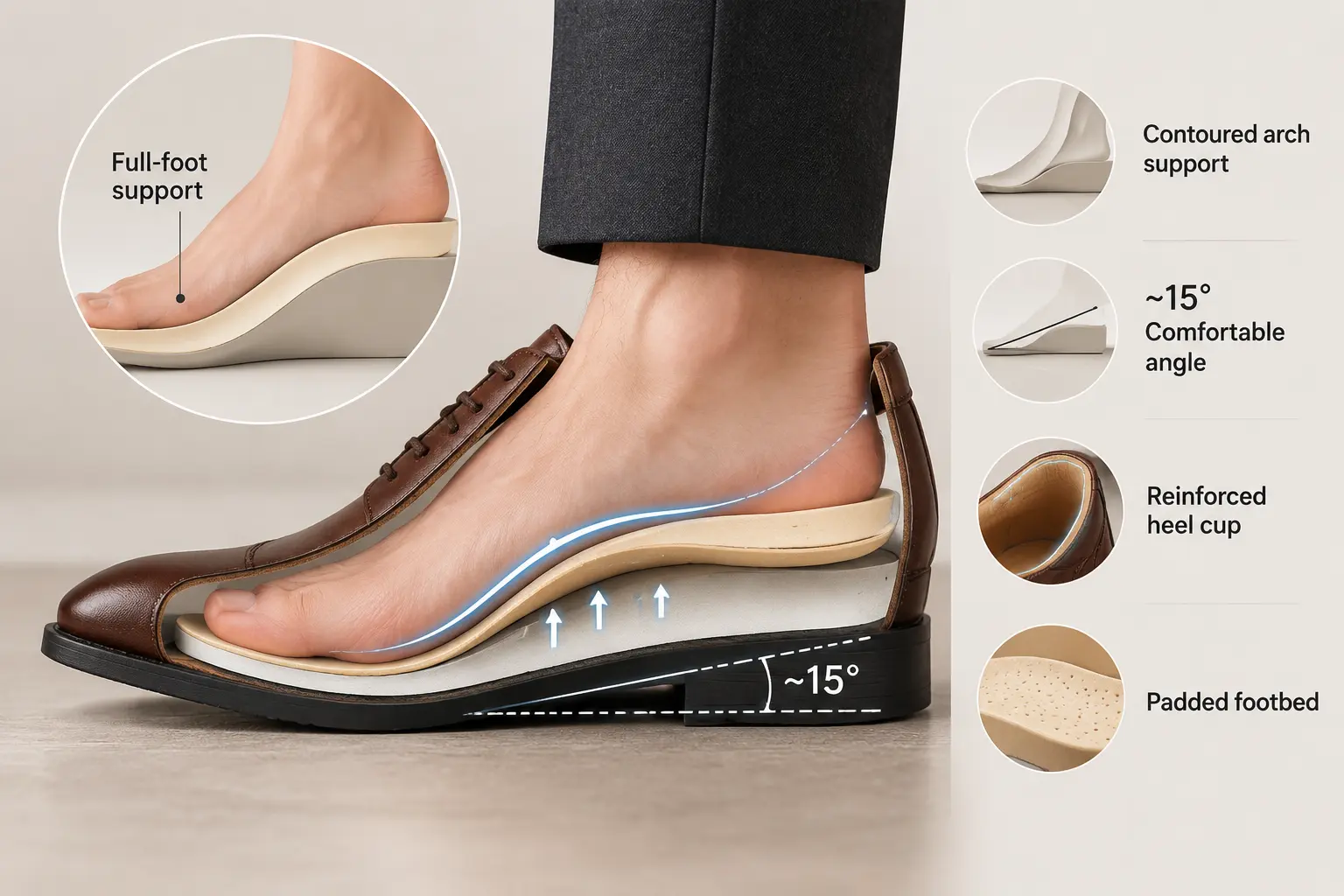
Look for:
- ✅ Contoured arch — distributes weight evenly
- ✅ Heel-to-toe incline ~15° — the biomechanically comfortable angle for elevated shoes
- ✅ Reinforced heel counter — prevents ankle rolling
- ✅ Padded footbed — cushions forefoot impact
A well-engineered pair should feel comfortable for 8+ hours on the first day, with only a brief 1–3 day adaptation period for your calf muscles.
5. Toe Box Room
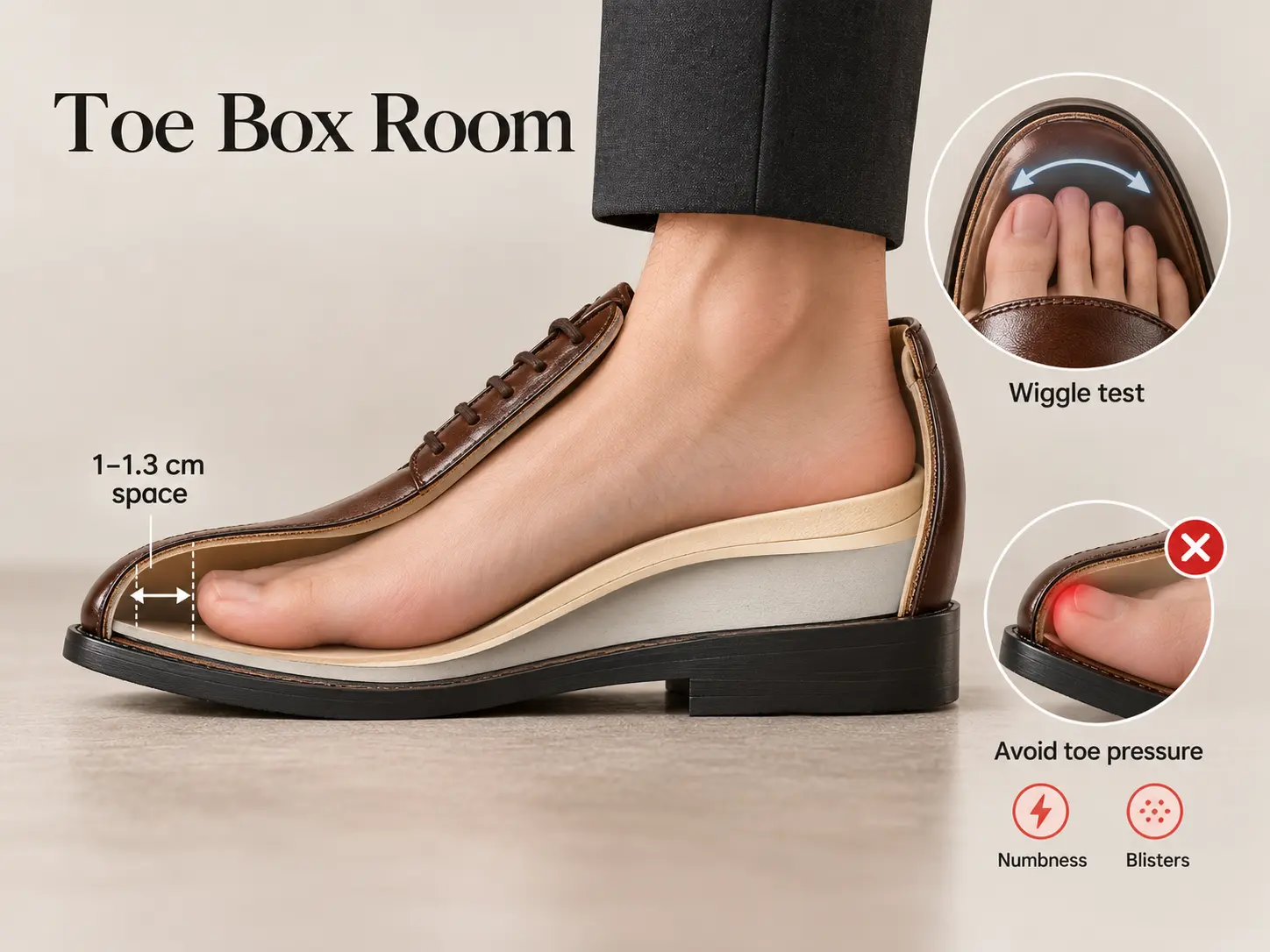
The internal lift pushes your foot upward and forward, making toe box design more critical than in regular shoes.
- ✅ Thumb’s width rule: ~1–1.3 cm of space between your longest toe and the front
- ✅ Wiggle test: you should be able to wiggle all five toes comfortably
- ❌ Warning signs: toes touching the front, numbness after 30 minutes, top-of-foot pressure
Compressed toes in cheap elevator shoes lead to blisters, bunions, and even nerve damage over time.
6. Outsole Type
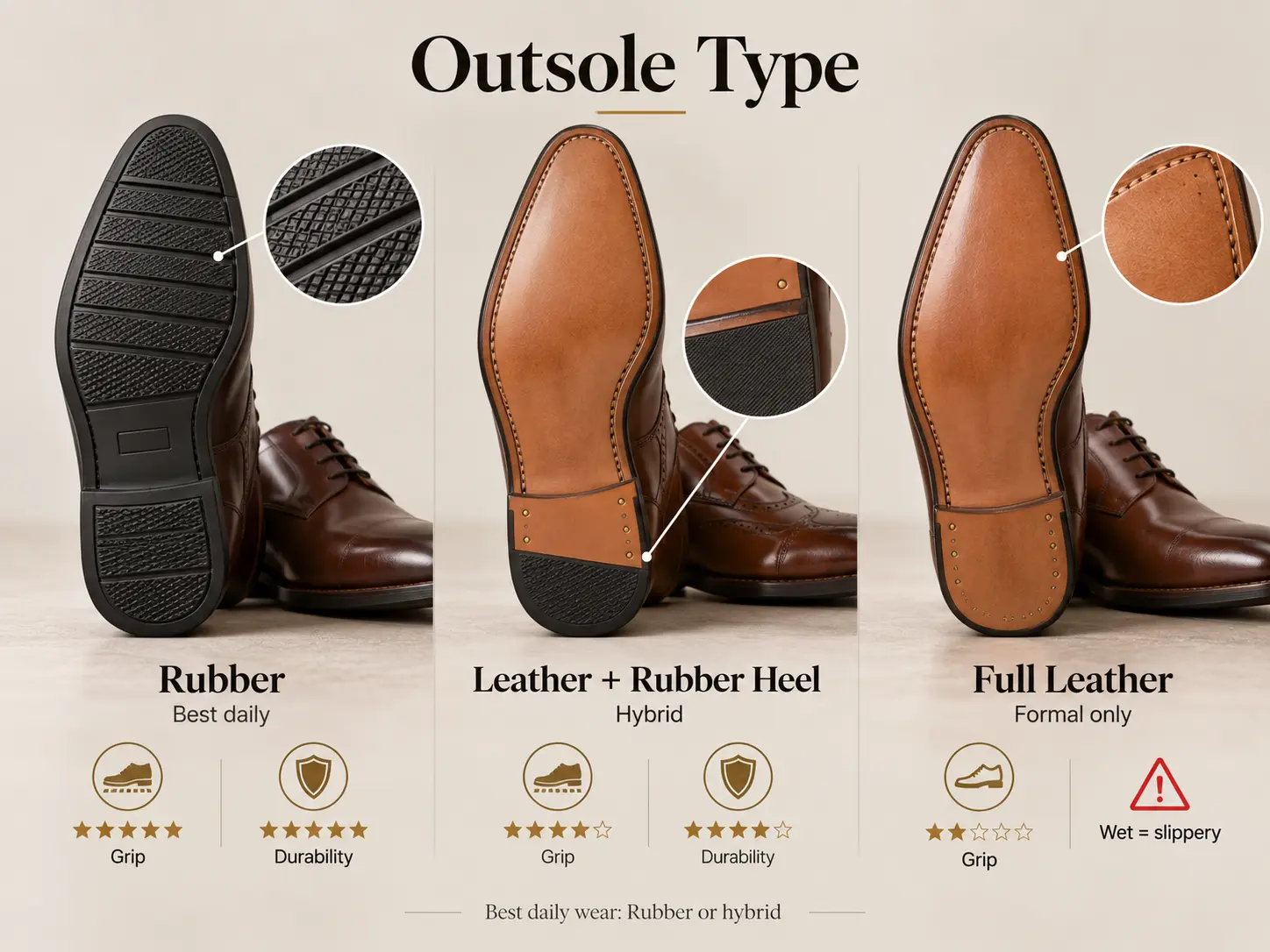
| Outsole | Grip | Durability | Best For |
|---|---|---|---|
| Rubber | ⭐⭐⭐⭐⭐ | ⭐⭐⭐⭐⭐ | Daily wear, rain, all-terrain |
| Leather + Rubber Heel | ⭐⭐⭐⭐ | ⭐⭐⭐⭐ | Formal + practical hybrid |
| Full Leather | ⭐⭐ | ⭐⭐⭐ | Formal events only — slippery on wet surfaces |
[!TIP]
Pure leather soles look elegant but are slippery when wet — a real safety concern when you’re on an elevated internal platform. For daily versatile wear, choose rubber or hybrid outsoles.
7. Style & Discretion
The whole point is that nobody notices. Different styles hide the lift differently:
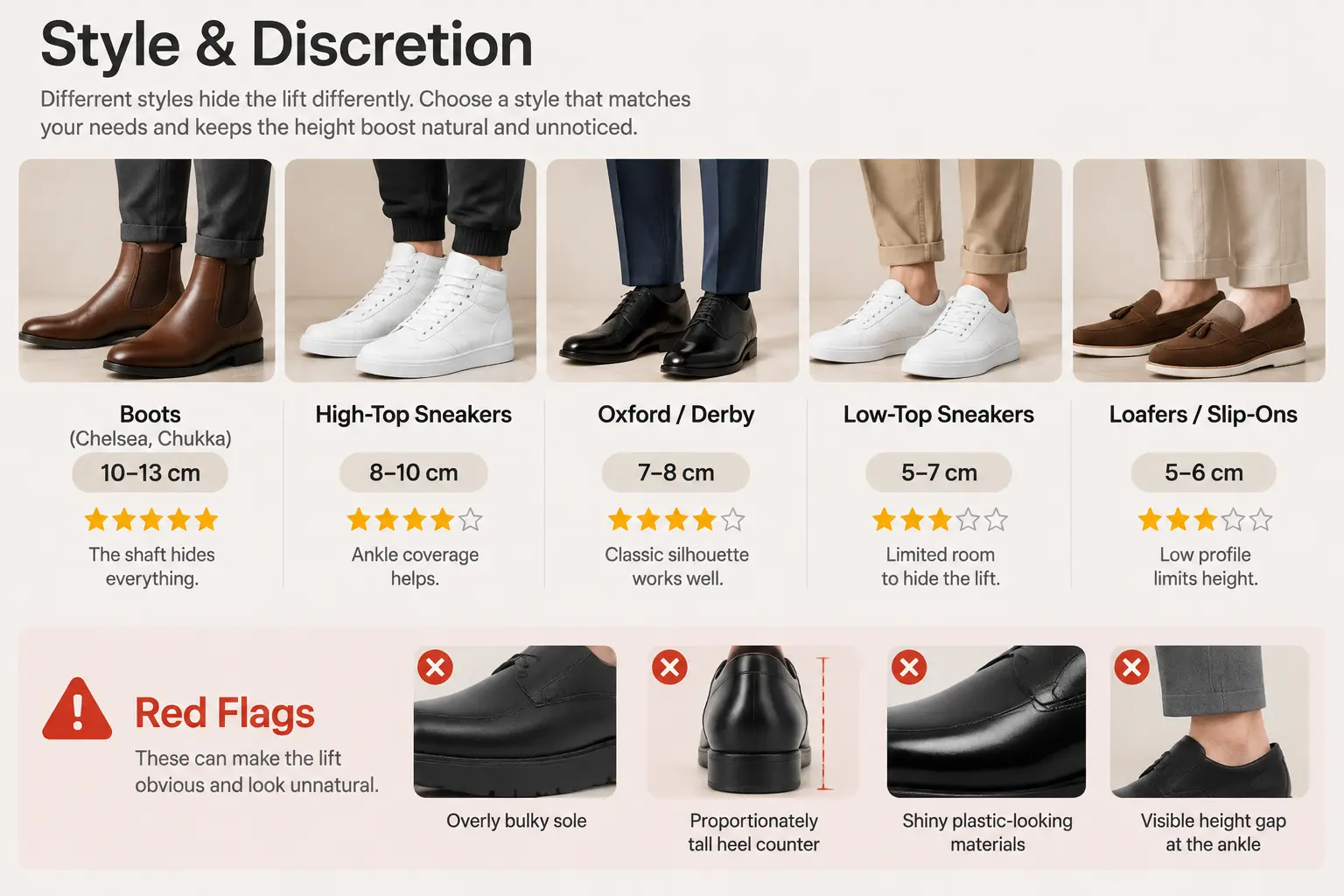
| Shoe Style | Max Discreet Height | Discretion |
|---|---|---|
| Boots (Chelsea, Chukka) | 10–13 cm | ⭐⭐⭐⭐⭐ The shaft hides everything |
| High-Top Sneakers | 8–10 cm | ⭐⭐⭐⭐ Ankle coverage helps |
| Oxford / Derby | 7–8 cm | ⭐⭐⭐⭐ Classic silhouette works well |
| Low-Top Sneakers | 5–7 cm | ⭐⭐⭐ Limited room to hide the lift |
| Loafers / Slip-Ons | 5–6 cm | ⭐⭐⭐ Low profile limits height |
Red flags 🚩: Overly bulky sole, disproportionately tall heel counter, shiny plastic-looking materials, or a visible height gap at the ankle when wearing pants.
8. Sizing & Fit
| Your Situation | Do This |
|---|---|
| Normal feet | Order your regular size |
| Between two sizes | Go half size up |
| Wide feet or high instep | Go half size up |
| Wearing with thick socks | Go half size up |
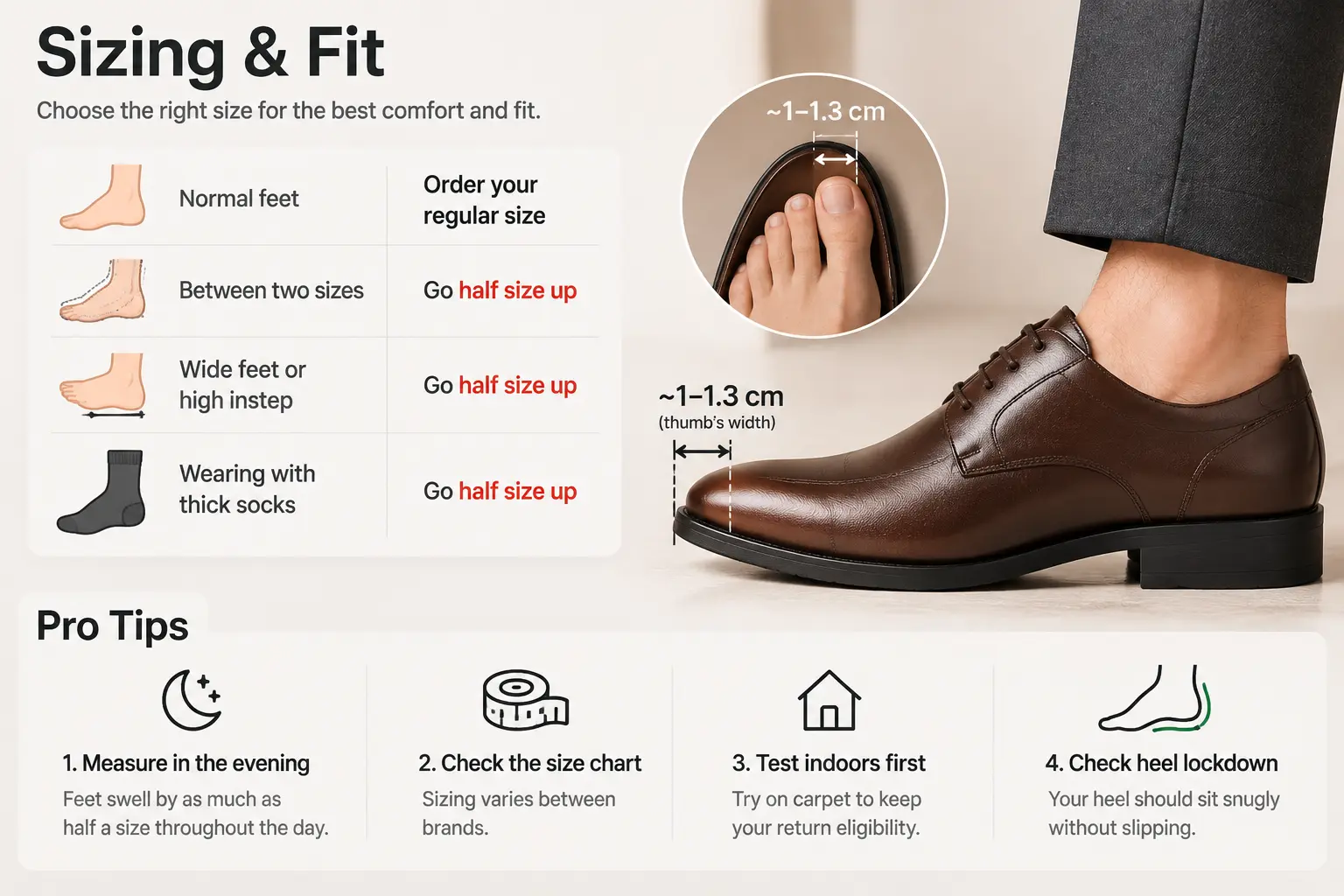
Pro tips:
- Measure feet in the evening — feet swell by as much as half a size throughout the day
- Always check the brand’s specific size chart — sizing varies significantly between manufacturers
- Test indoors on carpet first — preserves return eligibility
- Check heel lockdown — your heel should sit snugly without slipping
Elevator Shoes vs. Height Insoles — Which Should You Choose?
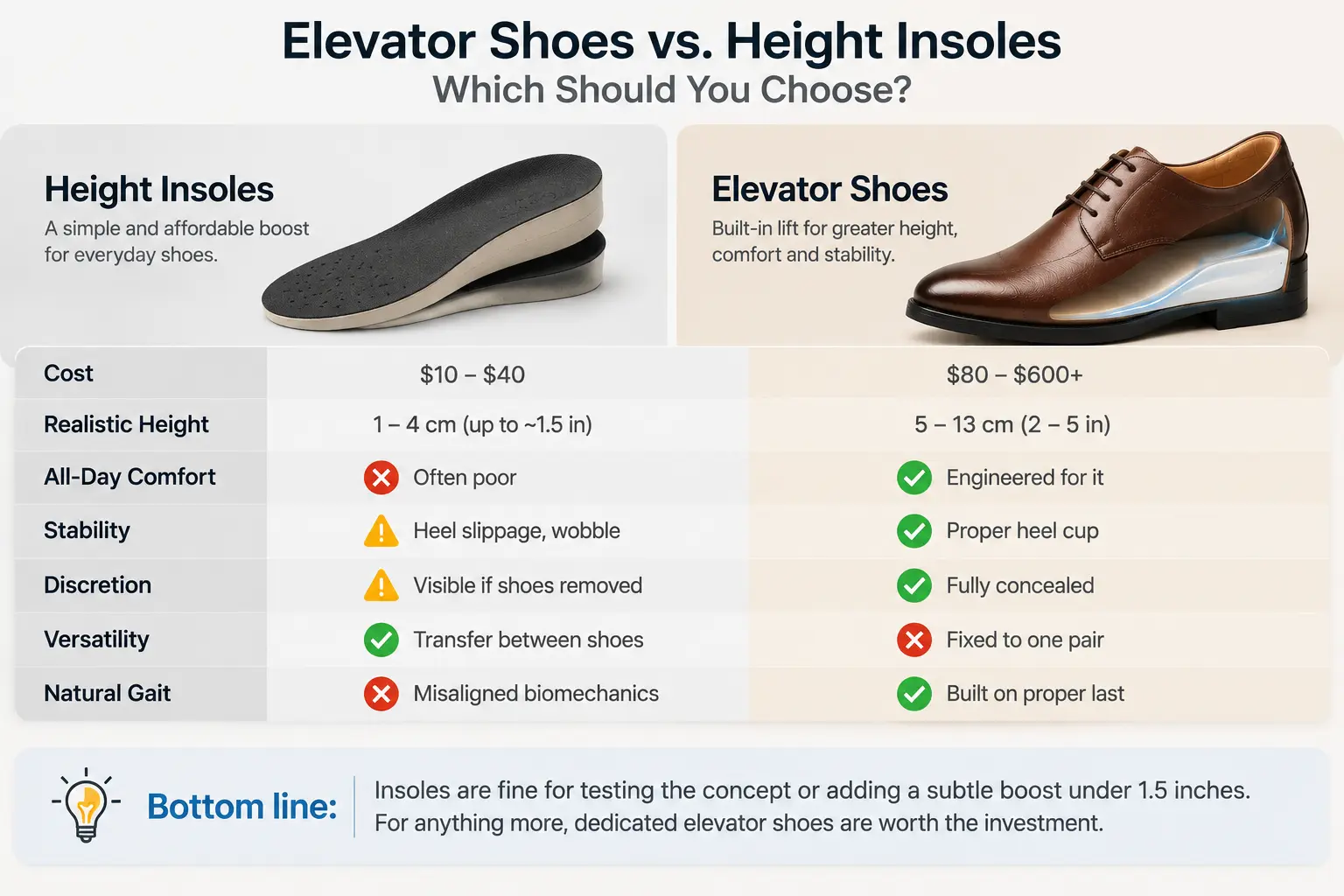
| Factor | Insoles | Elevator Shoes |
|---|---|---|
| Cost | \$10–\$40 | \$80–\$600+ |
| Realistic Height | 1–4 cm (up to ~1.5 in) | 5–13 cm (2–5 in) |
| All-Day Comfort | ❌ Often poor | ✅ Engineered for it |
| Stability | ⚠️ Heel slippage, wobble | ✅ Proper heel cup |
| Discretion | ⚠️ Visible if shoes removed | ✅ Fully concealed |
| Versatility | ✅ Transfer between shoes | ❌ Fixed to one pair |
| Natural Gait | ❌ Misaligned biomechanics | ✅ Built on proper last |
Bottom line: Insoles are fine for testing the concept or adding a subtle boost under 1.5 inches. For anything more, dedicated elevator shoes are worth the investment.
Price Tiers at a Glance
| Tier | Price | Examples | You Get |
|---|---|---|---|
| Budget | $60–$120 | Amazon generics | Functional, basic materials, good for testing |
| Mid-Range | $120–$250 | Chamaripa Regular | Wide variety, decent quality, read model-specific reviews |
| Luxury | $250–$800+ | Chamaripa Custom | Handmade, Goodyear-welted, virtually undetectable |
Health Essentials: Keep It Safe
Research on elevated footwear shows real biomechanical effects you should be aware of:
- 📌 Forefoot pressure increases with heel height — higher lift = more stress on the ball of your foot
- 📌 Achilles tendon adapts — prolonged use can shorten the tendon, causing discomfort in flat shoes
- 📌 Studies recommend staying below 5 cm to minimize adverse effects on gait
How to Minimize Risks
| Do This | Why |
|---|---|
| Stay at or below 7 cm | Maintains natural gait |
| Rotate with flat shoes | Prevents Achilles/calf shortening |
| Stretch calves daily | Counteracts the shortening effect |
| Stop if you feel pain | Persistent pain = wrong shoe or too much height |
[!CAUTION]
Persistent foot pain, ankle instability, or lower back pain means the shoe is poorly constructed, wrong size, or too high. Consult a podiatrist if symptoms persist.
Final Checklist
Before clicking “Buy”, run through this:
| ✅ | Check |
|---|---|
| ☐ | Lift is built-in, not a removable insert |
| ☐ | Lift material is PU or quality EVA (not cheap foam) |
| ☐ | Has a contoured arch support |
| ☐ | Heel cup is deep enough for the elevated position |
| ☐ | Toe box has adequate room (thumb’s width from longest toe) |
| ☐ | Height is ≤ 7 cm for daily comfort |
| ☐ | Style matches your wardrobe |
| ☐ | You’ve checked the brand’s specific size chart |
| ☐ | Return/exchange policy is confirmed |
| ☐ | You’ve read model-specific reviews (not just brand-level) |
References
- NIH/PubMed. Studies on heel height, plantar pressure distribution, and gait biomechanics.
- Kirby Allison / Gentleman’s Gazette. Goodyear welt construction explained.
- Footwear ergonomics literature. The ~15° heel-to-toe incline is cited across shoe engineering resources as the biomechanically optimal angle for elevated footwear.
- Chamaripa Official. One of the large elevator shoes brand.
- MDPI Sensors / NIH. Biomechanical analysis of high-heeled shoes — gait parameters and kinematic adaptations.
- NIH/PubMed. Studies recommending heel heights below 5 cm to minimize adverse biomechanical effects.
- American Podiatric Medical Association (APMA). General guidelines on footwear health.
Disclaimer: This article is for informational purposes only and does not constitute medical advice. Brand mentions are based on publicly available reviews and are not sponsored.